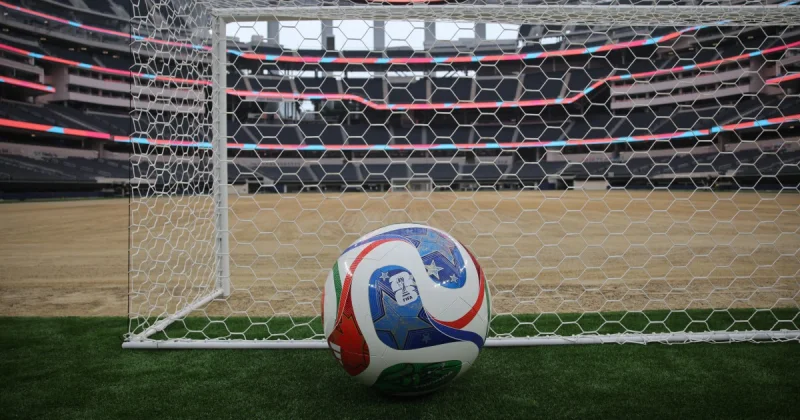
FIFA has named Trionda as the official match ball for the 2026 World Cup, and the ball will carry a small sensor chip that sends data to video assistant referees in real time. The system is built to track the ball’s acceleration and granular movement in three dimensions, giving officials a new layer of information when they judge close calls, including offside incidents.
The name itself points to the tournament’s shape. Trionda is Spanish for three waves, a nod to the World Cup being staged across the United States, Mexico and Canada in 2026. The same event will use the technology in all 104 matches during a 39-day tournament, making the ball part of a broader push to put more data into the officiating process from the first whistle to the last.
Nicolas Evans, who described the sensor, said it shows “what the ball is doing in a 3D space.” FIFA said the inertial measurement unit inside the ball captures information 500 times per second and sends precise data to VAR as play unfolds. That matters because offside decisions can turn on inches, and the new feed is meant to help match officials judge those moments faster and with more consistency.
The ball is only one part of a larger technology rollout. Players will be digitally scanned to create precise 3D models, with each scan taking about one second, and FIFA said those models will help track players reliably during fast or obstructed movement. AI-enabled 3D player avatars are being treated as a major step in semi-automated offside technology, and the models will be built into the host broadcast so offside rulings are displayed more realistically and more engagingly to fans in stadiums and viewers around the world.
That is where the new system goes beyond raw officiating. FIFA is not only trying to make decisions faster; it is also changing how those decisions are shown and experienced. Referee body cameras will be used in all 104 matches as well, while Mexican police are planning robotic dogs designed to enter dangerous areas and broadcast live video back to security forces. The result is a tournament being wrapped in sensors, cameras and AI before a ball is even kicked.
What remains unclear is how often the technology will alter the outcome of a match rather than simply the way that outcome is explained. The 2026 World Cup may end up remembered not just for its three-country staging, but for the moment the world’s most watched game started to look back at itself in real time.