


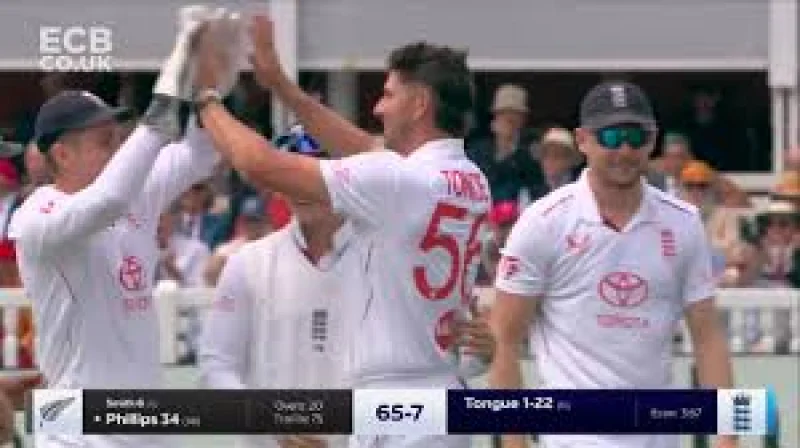
England went from 126 for 2 to 127 for 4 in the space of 11 balls on the second day of the first men’s Test against New Zealand at Lord’s, and a promising innings suddenly looked fragile. Ben Stokes, Joe Root and Harry Brook were all swept away in a brief burst that turned the match in a matter of minutes.
That is why readers were searching for the England Cricket Team Vs New Zealand National Cricket Team Match Scorecard while the day was still unfolding at Lord’s. The scoreline changed so fast that the numbers alone told the story: four wickets for one run, with New Zealand’s seamers making the most of cloudy conditions and a surface that kept offering just enough to keep England under pressure.
The collapse began with Stokes, who was bowled by Nathan Smith, before Root fell for 8 after reviewing an lbw decision off the same bowler. Harry Brook then went for a duck after being given lbw to Will O’Rourke, leaving England 126 for 2 and then suddenly scrambling at 127 for 4. A voice on the live feed summed up the mood as it happened: “England have lost four wickets for one run in 11 balls.”
Emilio Gay had at least given England something sturdier to hold on to before the slump. On debut, he made 56 and became the first England opener to score a fifty on debut since Haseen Hameed and Keaton Jennings on the 2016-17 tour of India, a small but notable landmark in a batting effort that otherwise unraveled fast. Nathan Smith eventually ended Gay’s innings with a thin edge to Tom Blundell, closing out a passage of play in which New Zealand were sharp, accurate and relentless.
The wider backdrop matters because this was not just any Test innings; it was the first men’s Test between England and New Zealand at Lord’s, and the second day had already become a test of nerve. New Zealand’s bowling, helped by the clouds overhead, forced England into a stretch they could not absorb, and Root’s latest low score will only deepen the scrutiny on a batter who rarely has two single-figure innings in a Test. England still needed a way out of the hole, but after that 11-ball collapse, the more immediate question was how much damage the lower order could prevent before the innings ran out of road.
