


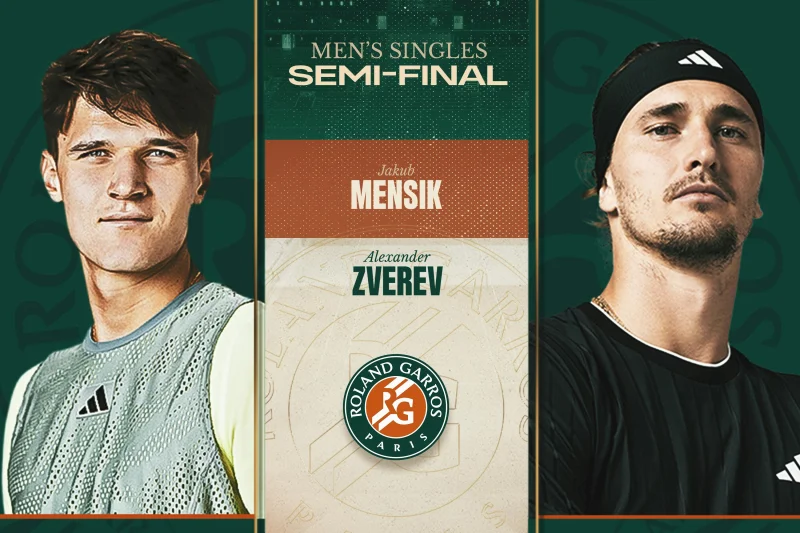
Jakub Mensik and Alexander Zverev met in the French Open 2026 men’s semi-finals on Friday, and the 20-year-old Czech made the first move by going up 1-0 in the opening set as live coverage updated at 1.30pm BST. It was the kind of start that fit the stage: the 26th seed arrived on court before Zverev, and for a brief moment he had the match on his racket.
The reason zverev vs mensik was drawing so much attention was simple enough. This was not a fresh matchup between strangers. It was their second meeting, after Zverev beat Mensik in three tight sets in the Madrid last 16 last month, 6-4, 6-7, 6-3. Mensik had even led by a break in the decider before Zverev steadied himself, and that result gave the German a measure of control going into Roland Garros.
But Mensik had already built a case that he belongs in these moments. He beat Novak Djokovic in three sets to win the Miami Open last year, then took down Jannik Sinner in Doha this year, results that made the 6ft 5in server look like more than a promising name on a draw sheet. He reached the semi-final in Paris after beating Alex de Minaur, Andrey Rublev and Joao Fonseca, and the path had already told its own story: two five-setters, two days off, and a body that had worked harder than Zverev’s by the time the last four began.
Zverev had the cleaner road. He came in having spent four hours less on court at the French Open than Mensik and had dropped only one set en route to his 11th grand slam semi-final. At 6ft 6in, he brought the bigger serve and the deeper major record, and he had the edge of experience in a match where every point could swing the mood of the court. He was also the 2024 runner-up, still chasing a first Grand Slam title that has eluded him for years.
That is what made this semi-final feel so live. Mensik had already shown he can beat stronger-ranked players and play with little fear when the stadium gets loud, which is why one coach said he looked born for exactly these occasions. Andre Agassi framed it even more plainly, saying the two had great backhands, that Zverev held the serve advantage while Mensik had the better forehand, and that if Zverev grew nervous while the Czech put pressure on the scoreboard, something special could happen.
For now, the only certainty was that the first men’s semi-final at Roland Garros had started with a teenager-sized ambition against a veteran’s record, and Mensik had drawn first blood. What remained was whether Zverev’s cleaner run and bigger experience would finally carry him into his first major final, or whether the 26th seed would turn another pressure match into the sort of upset that changes a tournament.
