


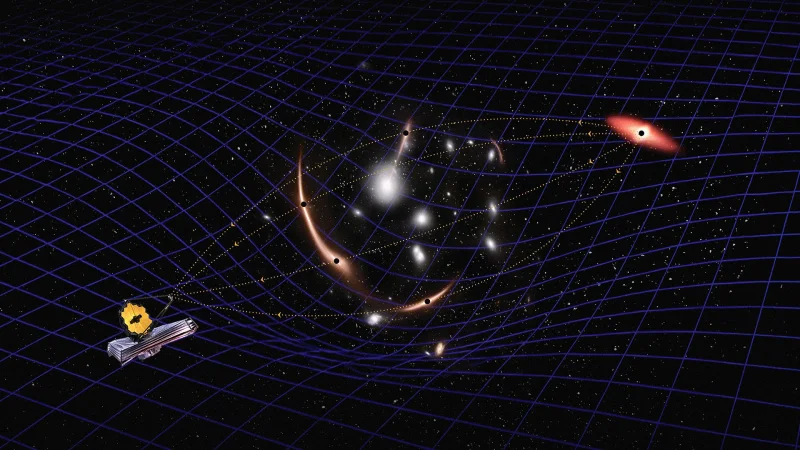
NASA’s James Webb Space Telescope has turned up direct evidence that some supermassive black holes were already enormous when the universe was young, and one of the clearest cases is a tiny object called Abell2744-QSO1. In new Webb observations, researchers traced the motion of gas around the source and calculated the black hole’s mass directly, rather than inferring it from assumptions.
The object, also known as QSO1, existed just 700 million years after the big bang. It is only 1,300 light-years across, yet it is magnified and triply imaged by the galaxy cluster Abell 2744, or Pandora’s Cluster, appearing in three different locations in the sky. That warped view gave astronomers a rare chance to study a prototypical Little Red Dot more closely, more than 13 billion years after its light left the early universe.
The result matters because the black hole is not small. Initial studies had already suggested QSO1 may be little more than a cloud of glowing hydrogen and helium gas circling a supermassive black hole estimated at 40 million times the mass of the Sun. Using the integral field unit on Webb’s NIRSpec, Ignas Juodžbalis and Cosimo Marconcini mapped the motions of hydrogen gas around it, while the gas itself showed Keplerian motion — the kind of orderly rotation that lets astronomers read the mass at the center. Juodžbalis said the data show most of QSO1’s mass is concentrated in the black hole, because if the mass were spread out as it would be in a star-rich system, the gas would not rotate so perfectly.
That is the break with the older picture. For years, scientists assumed black holes formed inside existing galaxies when large stars collapsed, then grew by swallowing material and merging with other black holes. Webb’s measurements point to a different possibility for at least some objects in the early universe: they may have been born already massive, without a stellar collapse phase and without a much larger host galaxy feeding them. Francesco D’Eugenio said all earlier mass estimates in the distant universe had been indirect and tied to assumptions from the local universe, where those assumptions may not hold.
Roberto Maiolino called the finding a remarkable one and said it amounts to a total revisiting of how black holes form and grow. The study, published in Nature and the Monthly Notices of the Royal Astronomical Society, does not explain how a black hole that large assembled so early. It does, however, make the unanswered part of the story sharper: whether QSO1 is a rare oddity or a sign that some of the first supermassive black holes took shape by a route astronomers have not yet identified.
