


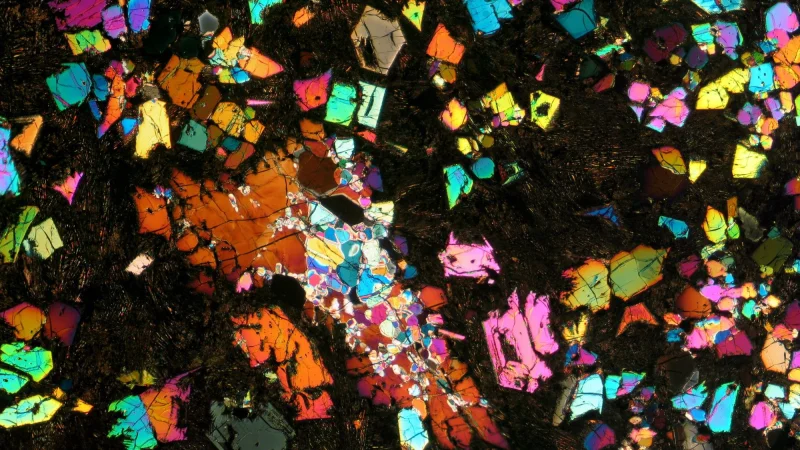
A rare meteorite found in the Sahara Desert has given scientists their clearest evidence yet of a long-lost world that may have been as large as the moon and existed in the solar system’s earliest days. The rock, Northwest Africa 12774, was recovered in 2019 and is now being read as a surviving fragment of a body that no longer exists.
Aaron Bell, who led the analysis, said the rock’s chemistry and texture point to a path of planet building that looks nothing like Earth’s or Mars’. He said the materials that formed the angrite parent body were fundamentally different from the ingredients of Earth and Mars, and that these meteorites preserved evidence of a completely different pathway through which early planets developed.
That matters because Northwest Africa 12774 is not an ordinary space rock. The 1-pound, 454-gram specimen belongs to the angrite family, one of the rarest classes of meteorite known to science. Angrites are among the oldest volcanic rocks in the solar system, formed alongside the young sun more than 4.5 billion years ago, and only 68 of more than 80,000 meteorites recovered on Earth are known to be angrites.
Bell’s team focused on crystals of clinopyroxene inside the meteorite that were exceptionally rich in aluminum. To form, those crystals needed pressures of at least 17.5 kilobars, more than 17 times the pressure at the bottom of the Mariana Trench. That is far more than scientists expected from a small asteroid, and it points instead to a much larger parent body, one big enough to create and hold deep internal pressure.
That finding cuts against a long-held assumption about angrites. Because they contain very little silica compared with Earth, Mars and most other rocky worlds, scientists had usually linked them to a relatively small asteroid. The new pressure evidence suggests the body that produced Northwest Africa 12774 was much larger, and that its crystals preserved features that would normally have been erased during long stretches deep inside a hot planetary interior.
The implication is not that scientists have identified the lost world itself. It is that a rock recovered from the Sahara in 2019 may be carrying the first definitive physical record of a planetary body that formed early, evolved differently and then disappeared. What remains now is the harder job: turning one meteorite into a fuller picture of how some of the solar system’s first rocky worlds were built.
