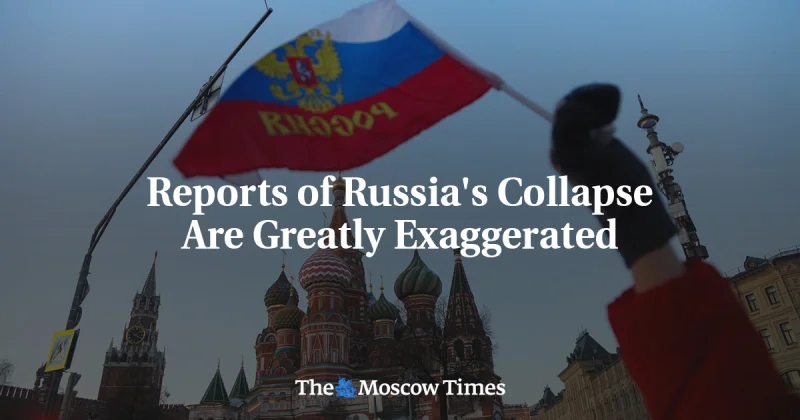
Russia’s economy has again done what so many outside observers said it could not do: it has stayed afloat. The repeated forecasts of collapse have not materialized, even as Russia wages war against its neighbor and its political system grows more authoritarian.
That is why the economy of Russia is back in focus today. People are still asking whether the country is weakening now because the warning signs have been circulating for years — sanctions, corruption, political strain and population decline — and because the latest arguments go beyond economics to predict a military breakdown or even a coup in Moscow.
The record behind those warnings is long. Russia was cast as near collapse in 1999, then again in 2008 and 2014, and a 2001 cover story in The Atlantic declared that “Russia is finished.” It was not. The same pattern has continued through newer claims that the Kremlin is one bad turn away from failure, or that the system is already cracking in ways that will force a dramatic break.
What keeps undercutting those predictions is simple: Russia’s economy has proven surprisingly resilient. It has withstood sanctions of historic proportions. Russia’s military has repeatedly shown an ability to adapt rather than collapse. And life inside the country has gone on in ways that are easy to overlook from afar, with new Hollywood releases, chic cafes and exhibitions still drawing civilians even as Russian cities are bombed and growth slows.
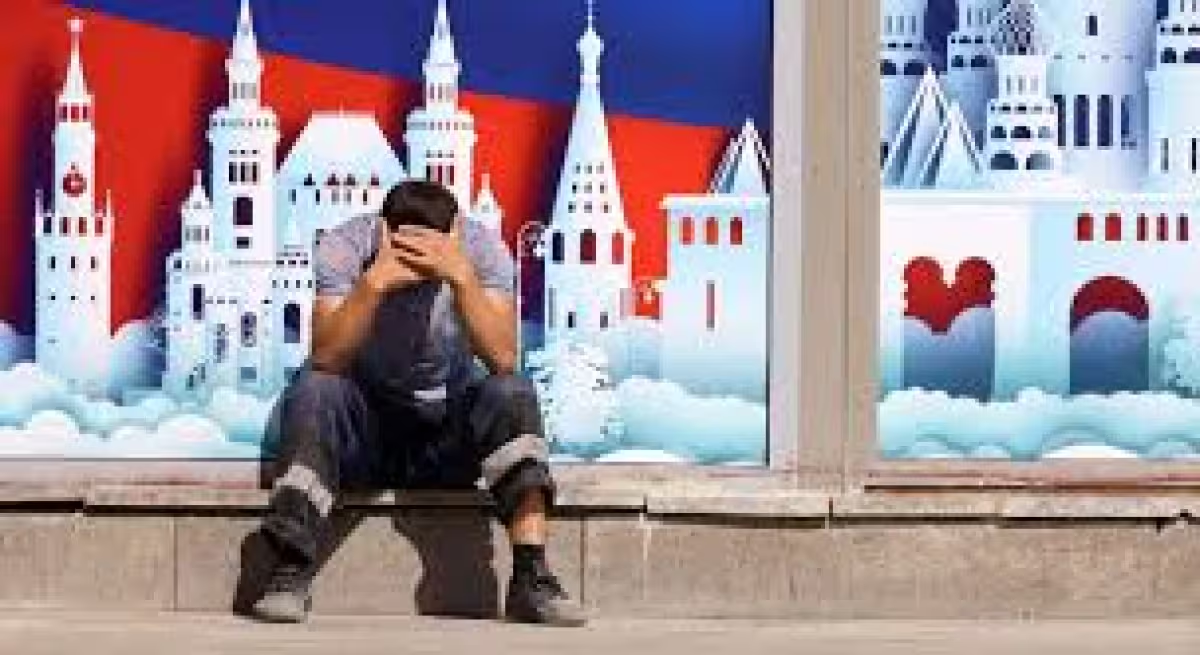
That resilience sits uneasily beside the picture of a war economy stretched to its limits. The system is overheated and tied to the continuing conflict, which means the same war that has helped sustain it also exposes how dependent it is on the fighting continuing. The contradiction is the story: a country under heavy pressure, and yet one that has not broken in the way many analysts kept expecting.
The distance between those forecasts and reality has widened as Western expertise on Russia has weakened. Many Russia studies departments at think tanks and universities are shutting down or losing funding, and the institutions around them have been strained by management and financial problems. At the same time, Russia has become more isolated from Western researchers, a trend that began in 2014 and worsened in 2022 after Russian institutions backed Putin’s invasion of Ukraine.
For many Western Russianists, that meant being de facto and often officially banned from the country they study, leaving very few experts able to travel there safely and see things for themselves. Meanwhile, Russian diplomacy has been making headway in the Global South, where state-affiliated media remain influential and student exchange programs are still in full swing. The result is a debate over Russia that is increasingly shaped by distance, not access.
So the central question is not whether collapse has already arrived. It has not. The harder question is how long a war-driven economy can keep absorbing sanctions, damage and isolation while remaining resilient enough to frustrate every new prediction of its end.