


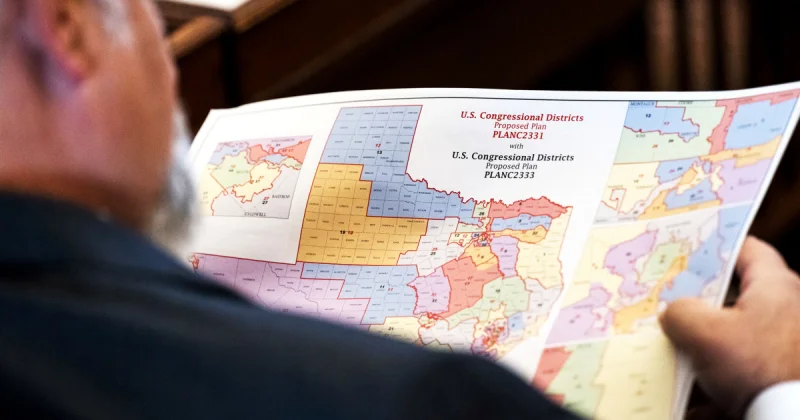
The U.S. Supreme Court’s latest voting-rights ruling has snapped the redistricting fight back toward Republicans, clearing the way for new congressional maps that could hand them as many as 16 House seats this fall. The shift comes with the general election only five months away and leaves Democrats with a far narrower path to offset the damage.
For Gavin Newsom, that means the California map he championed last November now sits in a much larger national scramble. Voters in the state approved the Democratic-led plan, and it could produce upward of five more seats for Democrats, but that gain is now only one piece of a much bigger and more aggressive map war playing out across the country.
By the end of April, Democrats had managed to draw enough favorable districts to leave the back-and-forth roughly even. Since then, the ground has moved. A week after the Supreme Court gutted the Voting Rights Act, the Virginia Supreme Court blocked the state from using a new map that would have favored Democrats. Republican-led states in the South then used the opening to push through maps that could erase majority-Black districts held by Democrats, changing the balance again.

The most recent moves came in Alabama, Louisiana and Tennessee. On Tuesday night, the Supreme Court cleared the way for Alabama to use its preferred map, originally drawn in 2023 and previously blocked by a federal court for discriminating against Black voters. That map is likely to cut the number of Democratic-held House seats in Alabama from two to one. Louisiana lawmakers, after the court struck down their earlier map in April as an unconstitutional racial gerrymander, passed a new plan that eliminates one of the state’s two majority-Black districts. Tennessee Republicans then carved up Memphis’s lone majority-Black district with a map that links urban liberal areas to rural Republican territory stretching hundreds of miles away, a design that is likely to leave the state with an all-Republican delegation.
Those changes matter because the fight is no longer confined to one region or one court. Ten states have now implemented new congressional boundaries over the past year, including Florida, where Republican lawmakers approved a map preferred by Gov. Ron DeSantis that creates four additional Republican-leaning seats, and Utah, where a judge ordered a new map with a solidly Democratic seat based in Salt Lake City. Republicans are now positioned to gain as many as 16 House seats under the new maps, while Democrats are in line for six. The net effect is a redistricting map that has moved from near parity to a clear edge for Republicans.
The unresolved question is not whether the maps will shape the House fight, but how many of them will survive. Litigation is still moving in several states, and the districts that ultimately stand in those places will help decide whether the Republican advantage holds when voters go to the polls this fall.
