


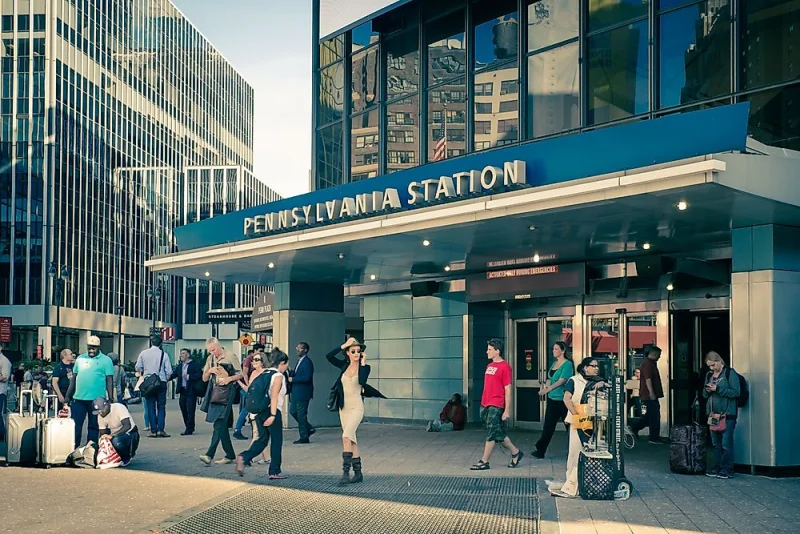
Penn Station is now the busiest train station in the Western Hemisphere, a title backed by more than 13 million intercity passengers in fiscal year 2025. The Midtown Manhattan hub also remains Amtrak's single busiest station, underscoring its reach far beyond the commuters who pour through it every day.
The numbers matter because this is not just a platform count or a branding claim. Penn Station sits beneath Madison Square Garden and moves well over half a million people on a typical weekday across 21 tracks fed by seven tunnels, with Amtrak, the Long Island Rail Road, NJ Transit and several subway lines all using the complex. For travelers searching rail rankings today, it is the scale of the station that stands out: this is the country's busiest transit hub, and one of the few places where commuter and intercity rail collide at full volume.

The top spot also puts Penn Station in a different light from New York's other great terminal. Grand Central Terminal, which opened in 1913 and has 44 platforms serving 67 tracks on two underground levels, has more platforms than any other station in the world. But Amtrak moved its trains from Grand Central to Penn Station in 1991, and that shift still shapes the intercity leaderboard. Grand Central later gained the Long Island Rail Road in 2023 through Grand Central Madison, a new cavern beneath the existing tracks.
Penn Station itself has gone through its own reinvention. The grand 1910 Beaux-Arts station that once stood there was demolished in 1963, and Moynihan Train Hall opened across Eighth Avenue in 2021 inside the old James A. Farley Post Office beneath a 92-foot glass skylight. The two halls now operate as one complex, giving the station a modern face while the traffic underneath keeps climbing.
That broader picture matters because the U.S. rail system still runs on a freight-heavy network, with intercity passenger service concentrated in a few corridors, especially the Northeast Corridor. Measured by total passengers, New York's commuter-heavy terminals lead the list; measured by intercity ridership, the busiest stops are mostly on the Northeast Corridor. Washington Union Station, opened in 1907, is Amtrak's second-busiest station with about 6 million intercity passengers in fiscal year 2025, while Philadelphia's William H. Gray III 30th Street Station ranks third with more than 5.5 million. For now, Penn Station sits alone at the top, and the gap is wide enough to keep it there.
