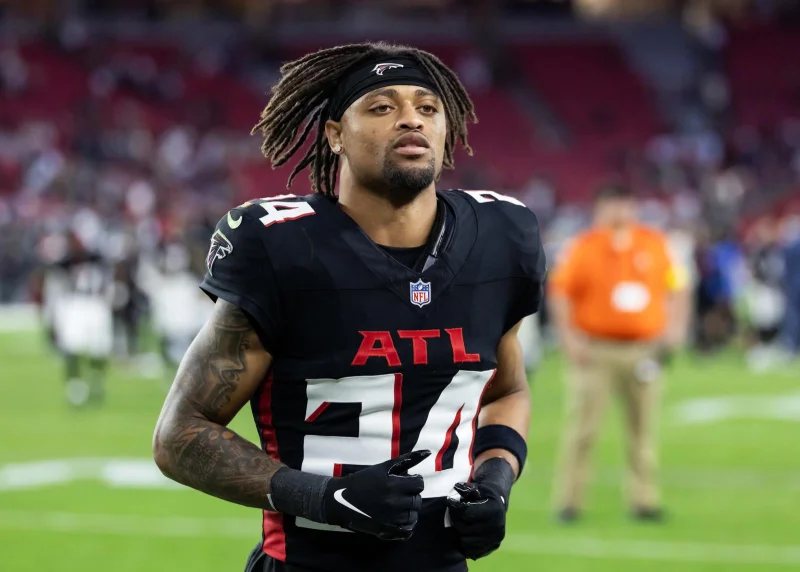
A.J. Terrell says the Falcons are already feeling Kevin Stefanski’s edge. The veteran cornerback said he loves that Stefanski has come in demanding more, pressing players to get better as Atlanta starts the slow work of defining what this team will be.
That matters now because the Falcons are in OTAs, when coaching language starts turning into habit and the first signs of a new identity begin to show. Terrell, 27, has been here since Atlanta drafted him in 2020, and he sees this regime as the fourth coaching and front-office setup he has worked under in his seven-year tenure. He said the goal is clear: get to the playoffs and give the team a chance at the dance.
Terrell’s praise was not really about comfort. It was about pressure. He said Stefanski’s approach is built on making the group better, and he liked the message enough to say so plainly. Stefanski has also been preaching the idea of building calluses, not blisters, and Terrell echoed the hard-edged tone when he repeated the coach’s repeated warning: “No collisions.”
Chris Lindstrom described the first days of OTAs as a little disorienting, saying he felt “like a baby deer” while getting used to Stefanski, Tommy Rees and Bill Callahan. The offensive lineman said the work around the building is centered on embodying the qualities Stefanski is emphasizing, and that the early task is less about flash than about setting standards and learning how everyone wants to communicate.
“Now, it’s establishing what the standard is going to be, what the standard you want to be is,” Lindstrom said. “Then kind of building that communication and working that foundation.” That is the part that can’t be faked in June, and it is also where Atlanta’s new brass is being judged first.
There is still a gap between the message and the proof. The Falcons have kept much of their defensive staff, including coordinator Jeff Ulbrich and secondary coach Justin Hood, which gives the group some continuity even as the broader leadership changes around it. Terrell acknowledged that the team is trying to find its identity under Stefanski, but he also said it may still be too early to know exactly what separates this regime from the last one.
That is the real test now. The Falcons are not being asked to explain their new culture; they are being asked to make it visible by the time the work of OTAs turns into the work that counts. If Stefanski’s demanding style sticks, Atlanta should start looking and sounding like a team that knows its standard long before the standings say whether it found one.