


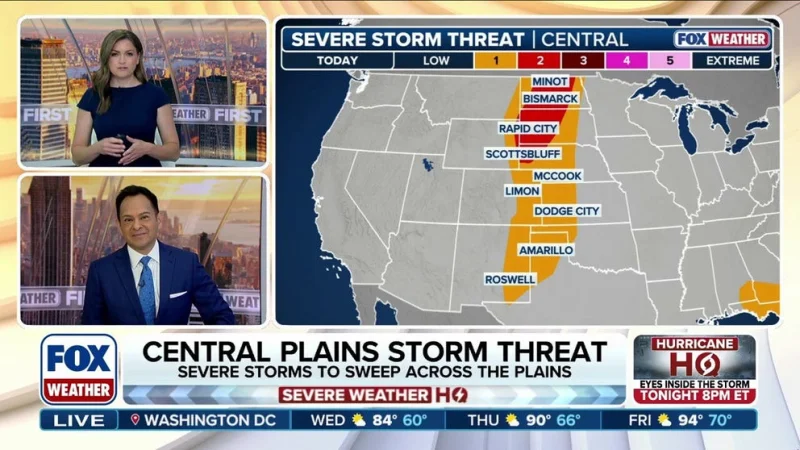
A multi-day severe weather episode is building across the Northern Plains on Tuesday, June 2, 2026, with a Slight Risk in place for Montana, Wyoming, the Dakotas and western Minnesota. The most dangerous stretch runs from Tuesday evening into early Wednesday morning, when storms are expected to organize into a fast-moving complex that could bring destructive wind, large hail and a narrow but real tornado threat.
The threat matters now because the window is immediate and broad: drivers and communities along I-90, I-94, I-25 and I-29 are in the path of a setup that can turn quickly after midafternoon. The Weather Prediction Center held a Level 2 out of 5 risk for both Tuesday and Wednesday, and the setup includes the kind of ingredients that can produce violent local impacts even when the coverage is uneven.
Initial storms are expected to fire by mid-to-late afternoon over eastern Montana and Wyoming, where high-terrain supercells can produce 2-inch hail or larger before clustering into a line. As that line races east along I-94 and I-90, it is expected to carry widespread 70 to 90 mph straight-line gusts, with localized 90 mph bursts possible once the system organizes overnight. The worst corridors include I-90 through Rapid City and Wall, I-94 from Miles City through Bismarck and Jamestown, I-25 in eastern Wyoming and I-29 north of Sioux Falls.
The setup is being driven by daytime heating, mid-60s dewpoints and CAPE values between 1,500 and 2,500 J/kg, while veering mid-level winds of 40 to 46 mph and effective shear of 45 to 50 knots help sustain rotating supercells. A cold front and trailing surface boundaries are providing lift, and the Weather Prediction Center has also placed North Dakota under a Level 2 out of 4 flash flooding risk for Tuesday.
The sharpest complication is that the tornado concern is not widespread across the whole region. It is localized, but it is credible, and the risk appears to strengthen late Wednesday afternoon near a secondary surface low along the North Dakota and South Dakota border. By then, the main threat zone is expected to shift east into central and eastern North Dakota, South Dakota and western Minnesota, leaving the question of which communities get hit hardest to the storms themselves once they form.
What is clear is that the Northern Plains are facing a two-day severe weather episode with enough wind, hail and instability to disrupt travel, threaten power and challenge late-day commuters from Montana to western Minnesota. By Wednesday, the storms should have moved east, but the most dangerous details will depend on how the initial cells organize Tuesday and how the overnight line evolves before sunrise.
