


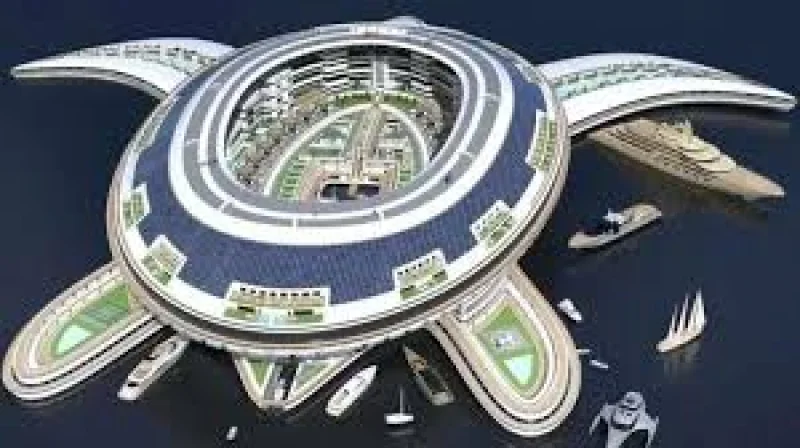
Pangeos has been unveiled as a gigantic floating city shaped like a sea turtle, with room for up to 60,000 people. The proposal imagines a vessel so large it would function as a moving city, with shopping centers, hotels, luxury villas, pools and its own ports for vessels and aircraft.
The project is now drawing attention because it is being presented as one of the most ambitious ideas in navigation, a vision that goes far beyond a traditional ship. For readers looking up the freedom ship floating city project, the pull is obvious: this is not a concept of a cruise holiday, but a plan for a mobile urban world built on the sea.
The design comes from the Italian studio Lazzarini Design Studio, which developed Pangeos with a vast silhouette inspired by a sea turtle. That shape is not just decorative. It is part of the pitch for a structure meant to be self-sufficient and able to travel to different parts of the world, putting it in the same conversation as some of the boldest maritime engineering proposals ever imagined.
But the biggest claim is also the least explained. The project is described as a self-sufficient floating city, yet no public detail in the proposal shows how such a place would supply power, water, food, waste management or basic day-to-day operations for tens of thousands of people while moving across oceans. That gap matters, because the scale is easy to picture and the mechanics are not.
Pangeos is still being described as a proposed engineering project, not a completed vessel, and there is no confirmed construction start or launch date. That leaves the design in a striking middle ground: ambitious enough to capture global attention, but unfinished enough that the most important questions are still about whether a city this large can be built at all.
