


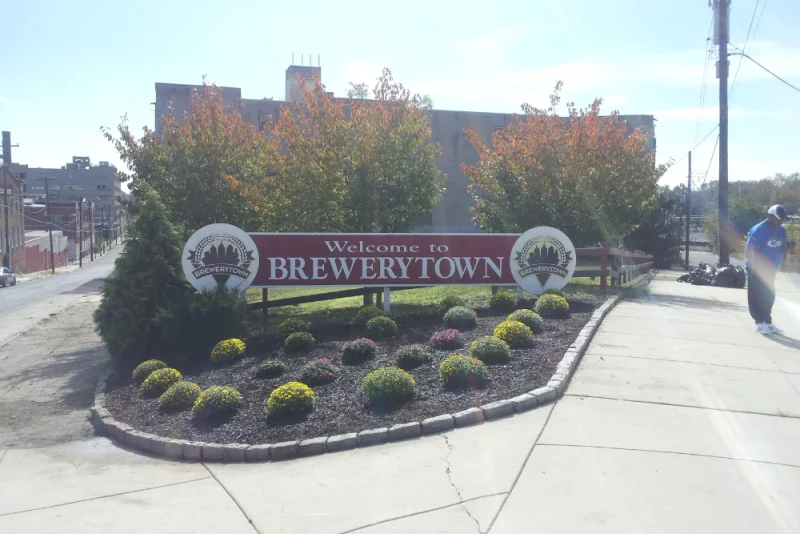
SEPTA’s Route 15, also known as the G1 trolley, returned to West Girard Avenue in June 2024 after a four-year shutdown, putting embedded rail back into the middle of Brewerytown’s south edge. For cyclists, drivers and trolley passengers, that means the corridor now looks and behaves like a streetcar route again, with rail ruts, loading islands and curbside conflict points back in play.
That is why people searching for an accident lawyer are looking at this stretch now. West Girard runs along Brewerytown’s southern edge, and the trolley tracks are cut into the pavement there, where a rail rut can catch a bicycle wheel and, after rain, tug at a car’s steering. The pressure points are not theoretical: loading islands sit at 29th, 30th and 31st Streets, and traffic also folds around new construction, old brewery shells and heavy neighborhood movement near Temple University and Fairmount Park.
Brewerytown has been shaped by that collision of old and new for years. The neighborhood was settled in the mid-19th century as a German-American brewing district, the last brewery closed in 1987, and the Brewerytown Historic District was listed in 1991. Since then, developers have converted brewery shells into apartments, including the Brewery Row project at 1229–1247 North 27th Street, while the Poth Brewery complex at 31st and Jefferson and the Bergdoll buildings remain part of the local streetscape.
The liability picture is just as layered as the block faces. SEPTA owns the rail, but a crash or injury on or near the corridor can also involve the city, a contractor, a jobsite property owner, a developer, PennDOT or Philadelphia Parks & Recreation, depending on where the incident happens and what caused it. Delivery activity at Aldi, 3101 West Girard, adds another regulatory layer, and family pickup at the Athletic Recreation Center, 1400 North 26th Street, can turn a curb lane into a hazard zone without much warning.
That mix matters because the deadlines do not wait for the facts to sort themselves out. Claims against SEPTA can trigger a six-month written notice rule, and that deadline is shorter than Pennsylvania’s two-year statute of limitations. In a corridor where the rail is back, the pavement is tight and the parties responsible may not be obvious at first glance, the first move is to identify who controlled the space before the clock runs out.
The restoration of Route 15 did more than bring back a trolley. It reactivated a street design that can produce wheel grabs, steering problems and multi-party claims in the same block, and the next question is not whether the hazard exists, but which entity is legally tied to the piece of street where the injury happened.
