


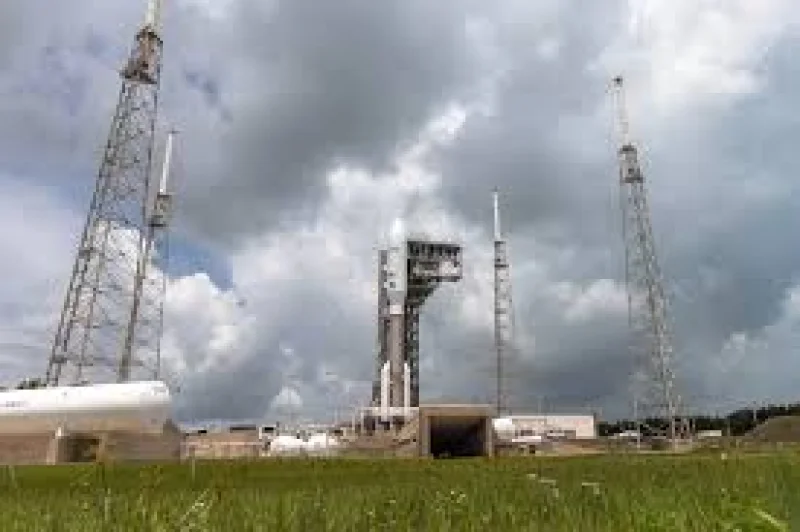
United Launch Alliance is set to launch 29 Amazon Leo broadband satellites on an Atlas 5 rocket from Cape Canaveral Space Force Station on Friday evening, but the weather outlook leaves the mission hanging by a thread. Liftoff from Space Launch Complex 41 is scheduled for 7:33:30 p.m. EDT, at the opening of a 29-minute window.
The countdown for the mission, which ULA calls Amazon Leo 7 and Amazon labels Leo Atlas 07, began at 12:13:30 p.m. EDT Friday. If the rocket leaves on time, it will carry 29 satellites into the seventh batch ULA has launched for Amazon’s broadband network, adding another piece to a constellation the company says will eventually grow to more than 3,200 satellites in low Earth orbit.
That is why the mission is drawing attention now. Amazon has only about 300 satellites in orbit as of Friday afternoon, and the company has been racing to build out service before a federal deadline that requires half the constellation to be operational by the end of July 2026. The Atlas 5 launch Friday would move that effort forward at a moment when the schedule is already tight.
The weather, though, is the biggest obstacle. The 45th Weather Squadron put the chance of acceptable conditions at 30 percent and said there was a high likelihood of launch rule violations on both the primary and backup days. Launch weather officers warned that an influx of moisture and westerly-to-southwesterly low-level winds will bring prime conditions for afternoon showers and thunderstorms along Florida’s east coast, with the Cumulus Cloud Rule, Anvil Cloud Rules and Surface Electric Fields Rule most likely to be a problem.
ULA says the rocket flying Friday is AV-113, the 109th Atlas 5 launch overall and the 22nd in the 551 configuration, which uses five solid rocket boosters. The vehicle is part of a shrinking supply of Atlas 5 rockets for Amazon. The company bought 47 launches from ULA — 38 on Vulcan and nine on Atlas 5 — and after this flight, one Atlas 5 remains for Amazon Leo.
The campaign has been slowed by problems elsewhere in the launch chain. Amazon had been counting on Blue Origin’s New Glenn to start carrying satellites as soon as June 4, but the rocket’s May 28 explosion seriously damaged the pad and knocked that path off course. Amazon Leo said Friday its satellites were at a payload processing facility at NASA’s Kennedy Space Center when that happened and were not harmed, while ULA said its own launch pad infrastructure was unaffected. For now, all attention is on whether Friday’s weather lets the Atlas 5 get off the pad at all.
