


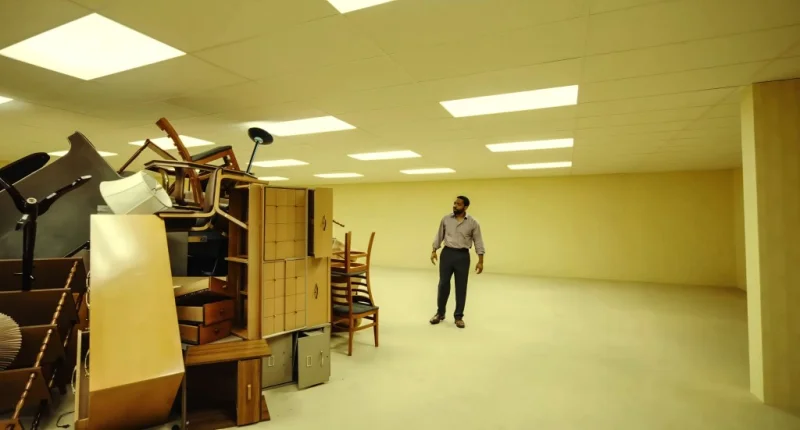
A24’s latest thriller, Backrooms, turns a viral internet nightmare into a feature film about a man who finds a portal to a mysterious realm in the basement of his showroom. The story follows Clark, an architect turned furniture store owner played by Chiwetel Ejiofor, as he tries to make sense of the space and explain it to his therapist, Dr. Mary Kline, played by Renate Reinsve.
The film arrives with a strange pedigree. It comes from Kane Parsons, who at 20 is the youngest director ever to work with A24, and who first built Backrooms as a series of YouTube shorts made with Blender and Adobe After Effects before it became a feature-length film. Parsons said the idea drew on a culture that keeps flattening itself into sameness. “We’re kind of getting stuck in this monoculture,” he said.
That sameness is the point of the dread. Backrooms moves through liminal spaces — offices, dead malls and other places that feel neither here nor there — and builds a world of fluorescent-lit rooms that seem to replicate forever. Parsons said, “There is probably no better symbol for that kind of monoculture than a drop ceiling.” He said he wanted to capture the feeling of infinite bureaucracy on screen, and the film does that by trapping Clark in a place that looks administrative, ordinary and impossible to escape.

The concept has roots that long predate the movie. The first image to bring liminal spaces into online conversation was posted in 2003, during the renovation of a furniture store in Oshkosh, Wisconsin. Since then, the idea has spread across online fandoms built around dead malls and other leftover modern spaces. The term also sits inside a longer critical tradition: Mark Augé called such places “non-places,” and Rem Koolhaas called them “Junkspace.” Airports, supermarkets, department stores and malls all fit the same uneasy category — spaces designed to move people through, not hold meaning.
Backrooms leans into that unease by withholding what should make a horror story legible. The film does not explain which entities govern the endless space, what lies beyond the doors and corridors, or what rules decide how the place works. Clark and Dr. Kline keep trying to map a system that refuses to be mapped, which is why the movie lands less like a puzzle than a trap. Its terror has been compared with giallo films such as Dario Argento’s Suspiria and Inferno, where the building itself feels alive and hostile.
That is the movie’s clearest answer: Backrooms is not really about a hidden world behind a basement wall. It is about a world that already feels overbuilt, overlit and mechanically repeated, then asking what happens when one man walks far enough into it to realize there may be no center at all.
