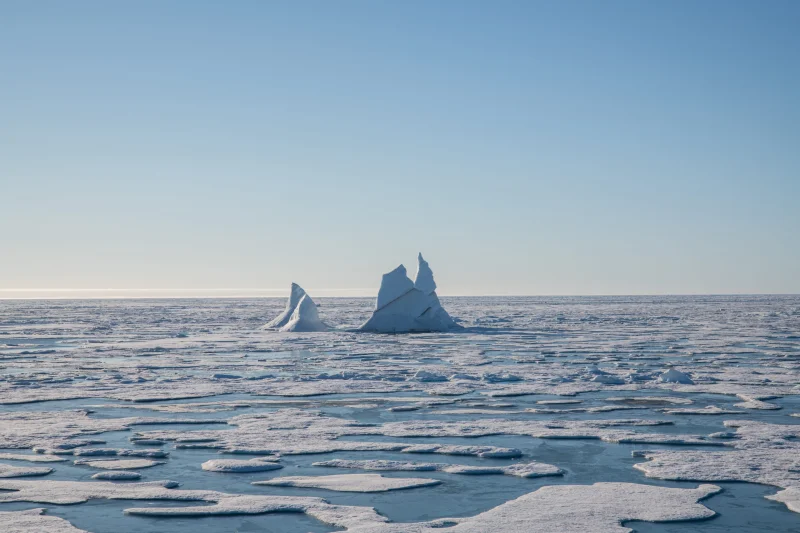
Climate change is driving a major and potentially permanent transformation in the Arctic Ocean, and scientists say the change is already cutting into the marine food chain from the bottom up. A new study found that nitrate levels in waters leaving the Arctic have fallen steadily since around 2009, a shift tied closely to the rapid loss of sea ice.
Researchers from the University of Edinburgh examined more than 20 years of ocean sampling data from Fram Strait, the gateway through which Arctic waters flow into the Atlantic Ocean. Their analysis showed a clear turning point beginning around 2009, when nitrate in the outflow began a sustained decline that matched the period of sharp acceleration in sea-ice loss.
Nitrate is a key nutrient for plankton, the microscopic organisms that form the base of the region’s ecosystem. As large areas of shallow Arctic waters once shielded by ice are exposed to more sunlight, the study suggests that a natural process called benthic denitrification has intensified. In that process, nitrate is converted into nitrogen gas in shallow seafloor regions, stripping the water of one of the ingredients plankton need to grow.
The implications stretch far beyond the Arctic’s edges. Continental shelf areas cover nearly half of the Arctic Ocean, giving this nutrient loss broad reach across the region. Researchers warn that nitrate-poor conditions may favor smaller plankton species in the future, and smaller plankton generally support less productive food webs. Slower plankton growth could also weaken the ocean’s ability to store carbon.
Marta Santos-García, one of the researchers involved, said the finding challenges the long-held expectation that sea-ice loss would simply boost phytoplankton growth by letting more sunlight reach the surface. She said the Arctic Ocean appears to have shifted from a system mainly limited by light, with the nutrient balance now changing in ways that were not expected.
The work was published in Communications Earth & Environment and supported by the Natural Environment Research Council’s Changing Arctic Ocean project. Scientists from the Norwegian Polar Institute, the Scottish Association for Marine Science, the Technical University of Denmark and the Alfred-Wegener-Institut in Germany also contributed to the study.
The wider picture is increasingly stark: the changing nutrient balance is linked to ongoing sea-ice decline, and researchers believe the Arctic Ocean is unlikely to return to its previous state. That makes the loss of nitrate more than a seasonal anomaly. It points to a new baseline for one of the planet’s most rapidly changing seas.