



General Motors posted first-quarter 2026 adjusted earnings of $3.70 per share, blowing past Wall Street expectations and helping extend a share rally that had already lifted the stock about 9.8% in the month since its last earnings report. The company also retained its lead in total U.S. sales, with 626,000 deliveries in the quarter.
Revenue came in at $43.62 billion, down 0.9% from a year earlier and slightly below the consensus mark of $43.94 billion. But the bottom line was stronger than the top line suggested. Adjusted earnings per share rose 33% from $2.78 a year ago and topped the estimate of $2.61 by 41.8%, while total company EBIT-adjusted climbed 21.9% to $4.25 billion and margin improved to 9.7%.
The quarter reflected strong execution in the core business alongside benefits tied to tariff-related adjustments. In North America, GM generated $36.4 billion in net revenue, down from $37.4 billion a year earlier, on wholesale sales of 793,000 units versus 827,000 units in the year-ago quarter. Even so, the region produced $3.66 billion in EBIT-adjusted profit and a 10.1% margin, including a 1.5-percentage-point benefit from the tariff adjustment.
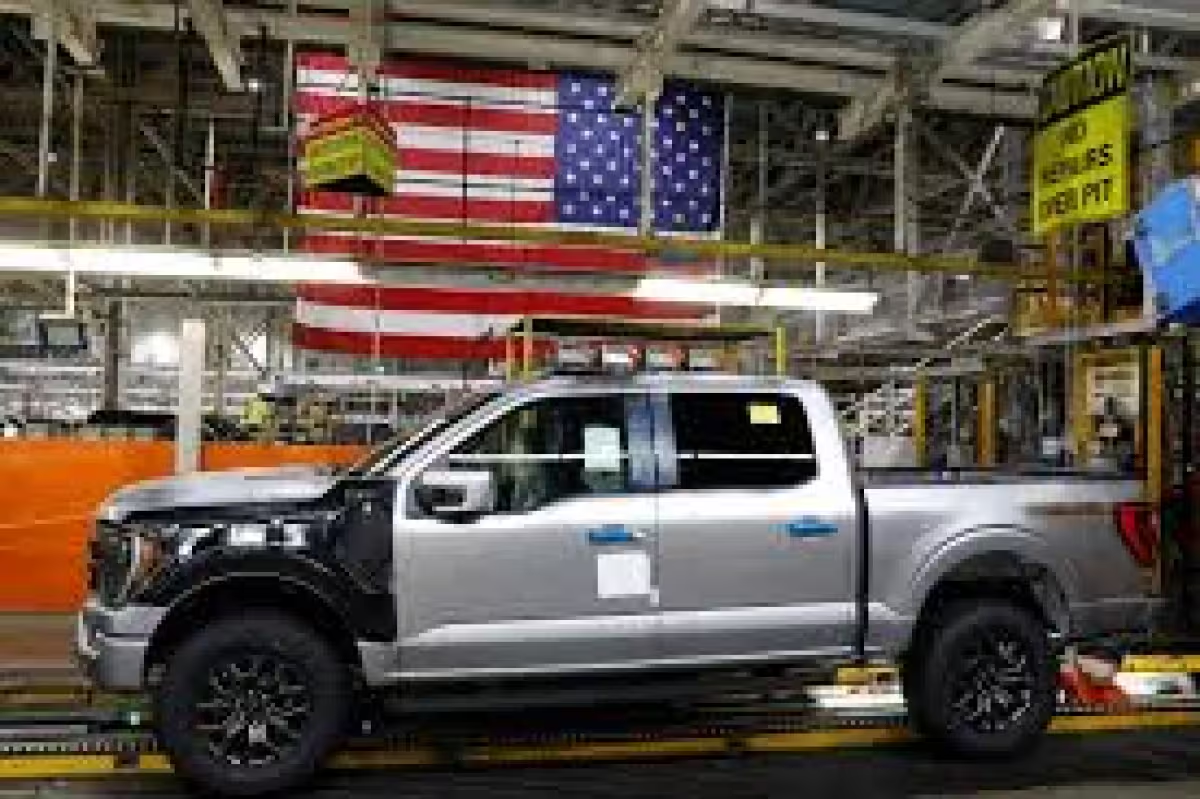
The U.S. market remained GM’s anchor. Its deliveries were supported by resilient demand for pickups and SUVs and strong fleet performance. Dealer inventory ended the period at 516,000 units, about 6% lower than a year earlier, while incentives were 4.4% of MSRP versus an industry average of 6.6%. GM said its average transaction price was $52,000.
Outside North America, the company’s international business improved. GM International posted $2.9 billion in net revenue, up from $2.4 billion a year earlier, on 106,000 wholesale vehicle sales, compared with 85,000 units in the prior-year quarter. EBIT-adjusted profit rose to $123 million from $30 million. China equity income also increased to $165 million.
GM Financial was stable, with net revenue of $4.27 billion, up from $4.16 billion, and adjusted earnings before taxes of $688 million, just above $685 million a year earlier. The software side of the business also showed momentum. Recognized Super Cruise revenues rose roughly 85% year over year, GM added about 50,000 new Super Cruise customers, and users drove 1.0 billion miles using the system. OnStar ended the quarter with $5.8 billion in deferred revenue, up more than 50% from a year earlier.
The numbers point to a company that is still leaning on its truck and SUV franchise, but is also building out higher-margin services that investors can track quarter by quarter. GM expects to surpass 850,000 paid Super Cruise subscribers by the end of 2026, giving the business another measure of whether its push into connected features can keep pace with the strength of its traditional operations.
