


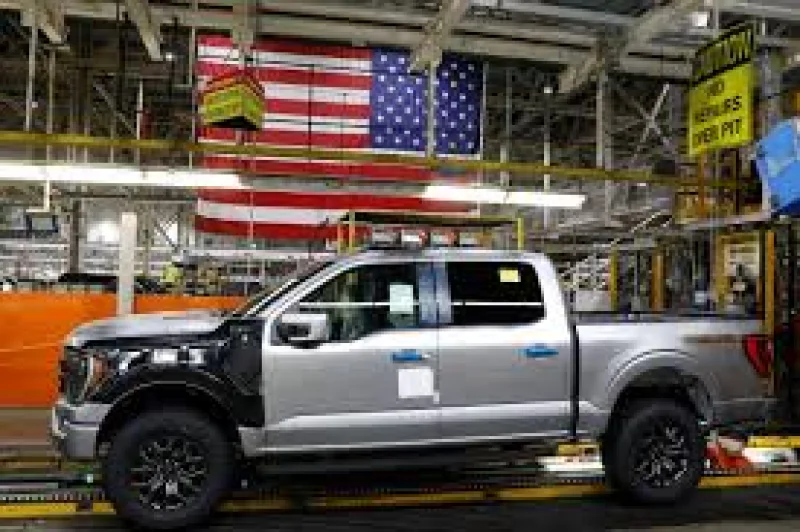
Ford Motor’s fair value estimate was cut to US$13.70 a share from US$14.09 after a wave of new analyst calls reshaped the case for F stock, with the company’s battery-storage push now moving closer to the center of the story. Morgan Stanley called Ford’s agreement with EDF its first big win for Ford Energy, while other firms said the deal gives investors a clearer line of sight to a new business that could matter as much as the carmaker’s traditional one.
RBC Capital said the five-year, 4 GWh per year EDF framework validates demand for Ford’s repurposed battery capacity and set a US$13 target on the shares. Barclays was more expansive, saying Ford Energy could become a US$3b revenue opportunity and a US$300m to US$500m EBIT opportunity, but it kept an Equal Weight rating and a US$13 target. The disconnect captures the stock’s current split identity: a legacy automaker with a fast-growing energy-storage arm that is still trying to prove it can scale.
That shift matters because Ford is trying to keep its electric vehicle roadmap intact even as some peers slow spending, and investors are weighing whether the company can turn that discipline into a cleaner earnings profile. BofA reinstated coverage with a Buy rating and a US$17 price target, pointing to Ford’s ability to focus on higher-margin trucks and SUVs and to its long-term 8% EBIT margin goal. The bank’s view stands in contrast to the caution from RBC and Barclays, which both flagged questions around execution and the pace at which Ford can turn promises into profit.

Those warnings were not abstract. RBC said there are uncertainties around component sourcing, profitability, and future capacity expansion, while Barclays said energy-storage execution and ramp risks remain real. Barclays also said Tesla remains the dominant competitor and that more capacity is still coming online, a reminder that Ford is entering a crowded market rather than a protected one. The company’s own latest valuation update reflects that tension: its revenue growth outlook was revised from a decline of 0.67% to a smaller decline of 0.34%, and its net profit margin assumption was raised from 4.94% to 7.52%.
Ford’s broader backdrop is also getting noisier. The reported talks about bringing Geely technology to the U.S., though said Ford denied discussions on a U.S. deal. said Ford, General Motors and Stellantis are under pressure to keep pace with Chinese carmakers and tech firms in electric vehicles and autonomous driving, while the and highlighted Pentagon outreach to Ford and GM on potential weapons production and renewed semiconductor supply chain risks tied to Nexperia chips. Together, those threads show a company that is being pushed in several directions at once.
The market is now judging Ford less on one clean story than on whether it can hold its automotive base while building a second engine in energy. That makes the EDF contract more than a single customer win: it is a test case for whether Ford Energy can justify the optimism building around it, or whether the latest price targets will prove too high for a business still working through the hard parts of scale.
