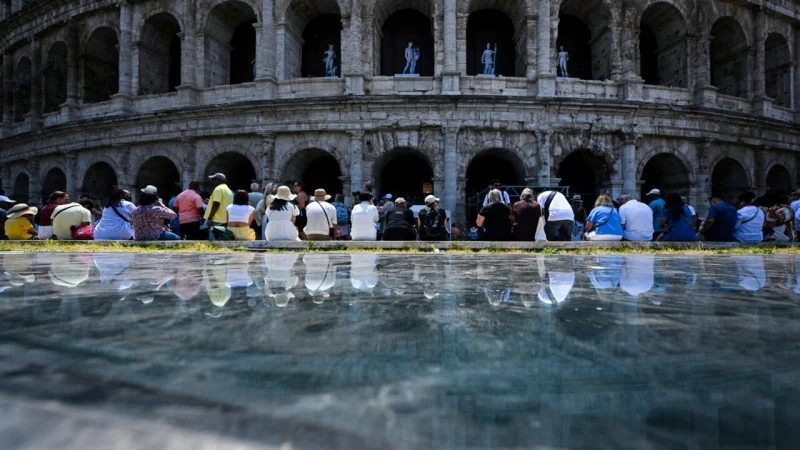
Italy issued its first red alert of the year for Rome on Thursday as a blast of early heat pushed the capital to 32C and spread across five cities, with Florence, Bologna, Brescia and Turin also covered by the warning. The alert, issued on 28 May 2026, was meant to flag possible negative effects on the health of healthy, active people, a sign that the heat had moved beyond discomfort and into a public health threat.
The warning came as Rome heat dome temperatures settled over western Europe and forced people across the region to change their routines. In Rome, Nana Martinez Garcia said, "We're sweating a lot," while Maria Angeles Mellinas Tello said people were trying to keep to the shade. Italy had so far been spared the highest temperatures before officials told people in the capital and four northern cities to stay out of the sun.
Elsewhere in the region, the scale of the heat was already showing up in the numbers. Portuguese authorities said the mercury peaked at 40.3C in Mora on Wednesday, a reading the national meteorological agency said topped the previous May record of 40C from May 2001. France and Portugal both reported their hottest May days during the heatwave, while Britain and France had already logged their hottest-ever May days earlier in the week.
In southwestern France, temperatures in Angouleme reached 37.8C on Thursday. A school in the same region shut its doors on Thursday and Friday afternoon after corridor temperatures hit 53C on Tuesday, a level that left teachers and staff scrambling to manage the heat. Florian Deygas said, "There was even someone who fainted and vomited," underlining how quickly the conditions had turned dangerous indoors as well as outside.
Paris was expected to reach 34C and remained on orange heatwave alert on Thursday, as the hot spell stayed locked over the region. In Portugal, Health Minister Ana Paula Martins said the heatwave had caused a spike in hospitalisations. Authorities in Britain and France also linked several deaths, mostly drowning accidents, to the heat as people sought relief in water.
The pattern fits a broader shift that scientists say is being intensified by human-driven climate change, which is amplifying heatwaves, droughts and floods. Philippe Vaillant, describing the kind of response needed to keep court surfaces from breaking up in extreme heat, said, "we flood the courts, we soak them, so as to replenish with water the different layers that make up the clay". For now, the bigger question is not whether the heat will fade, but how many more places in Europe will be forced to treat May like midsummer before the season has even begun.