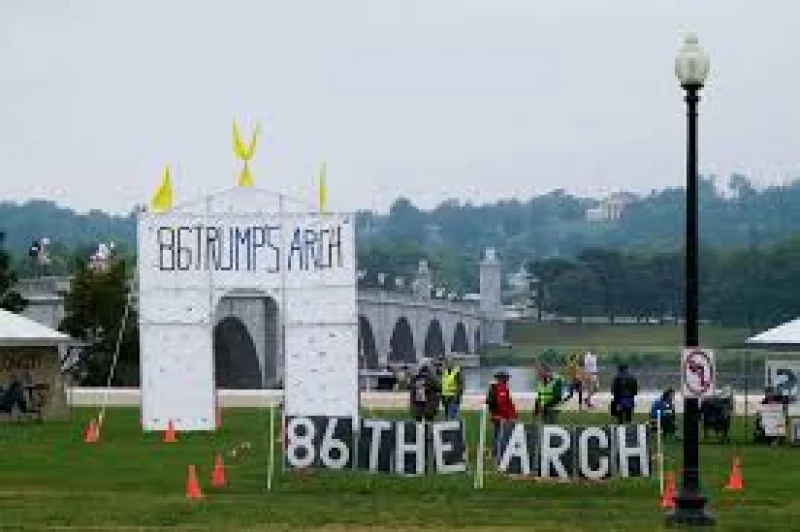
President Donald J. Trump’s proposed triumphal arch would sit on a rotary on the Virginia side of the Arlington Memorial Bridge, in a position that obscures the Lincoln Memorial and perfectly frames Arlington House. The placement would put the monument between Arlington National Cemetery and Washington’s most famous memorial, turning a site tied to Civil War burial into the visual center of the scene.
That matters because Arlington House was the mansion built by enslaved Americans and once owned by Confederate General Robert E. Lee, whose former plantation became the ground for one of the nation’s most hallowed burial sites. The proposed arch frames the home of the man who led the armies of the Confederacy that killed the soldiers buried at Arlington, a detail that gives the design its force and its trouble.
The land itself carries that history in layers. Lee resigned his commission after 32 years in the U.S. Army and took over command of the Army of Northern Virginia in 1862. After he defaulted on property taxes, the U.S. government bought his property at public auction in early 1864, and as the U.S. Army under General U.S. Grant began its spring 1864 offensive against Confederate forces, the place was transformed. On June 15, 1864, Secretary of War Edwin Stanton approved the land as a national burying ground for soldiers.

The burial ground filled fast. By August 1864, the government had buried the bodies of twenty-six U.S. soldiers around the perimeter of Mrs. Lee’s rose garden. By the end of the Civil War, more than 16,000 Civil War soldiers were buried at Arlington National Cemetery, after the dead piled up through the Wilderness Campaign, the Battle of the Wilderness, the Battle of Spotsylvania Court House, the Battle of Cold Harbor, and the siege of Petersburg.
The site’s role as a place of mourning was fixed on May 30, 1868, when the first official Memorial Day ceremony took place there. The day was then called Decoration Day, and the newly organized Grand Army of the Republic marked it with a speech by then-congressman James Garfield. He said the men buried at Arlington had “summed up and perfected, by one supreme act, the highest virtues of men and citizens,” and that “For love of country they accepted death, and thus…made immortal their patriotism and their virtue.”
That memory is why the arch has drawn attention beyond architecture. A monument that visually centers Arlington House also shifts the frame away from the Lincoln Memorial and away from the honored dead whose graves made the land nationally significant. The design does not just add another landmark to the capital. It chooses what the eye sees first at a place built out of war, loss and remembrance.
For now, the most important fact is the one the site itself cannot escape: the proposed arch would stand over ground that was turned from a Confederate plantation into a national cemetery, and its sightline would place Lee’s house at the middle of that story.