


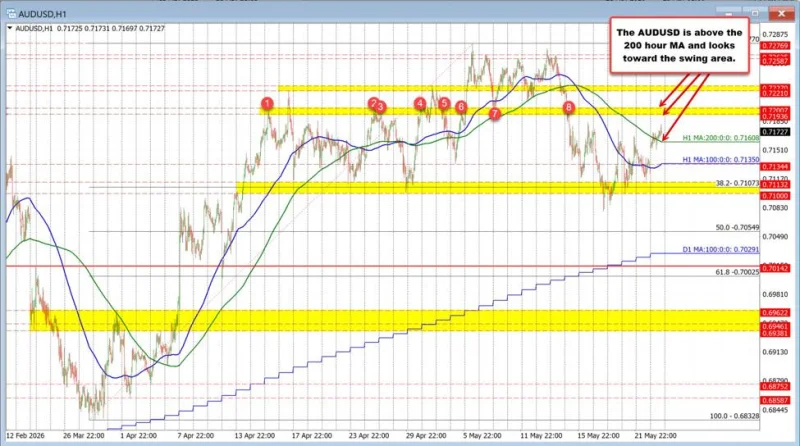
The Australian dollar traded near 0.7170 on Monday, up 0.60%, after finishing last week at 0.7128 and falling 0.28% as investors weighed softer domestic jobs data against a jump in expectations for more US tightening. President Donald Trump added a fresh geopolitical twist over the weekend, saying a “largely negotiated” memorandum of understanding had been reached to reopen the Strait of Hormuz.
The move came as Australia’s April labour report showed a noticeable slowdown in hiring and pushed unemployment to 4.5%, easing fears that the Reserve Bank of Australia would have to keep tightening aggressively into year end. That shift has left the cpi release as the key domestic event now in focus, because traders are trying to judge whether inflation is easing fast enough to change the RBA’s next move.
The weight behind that view is already clear in the numbers. Australia’s headline inflation rose 4.6% year-on-year in the 12 months to March 2026, its highest reading since September 2023, while housing inflation climbed 6.5% and was the biggest contributor to the annual pace. Transport rose 8.9%, and automotive fuel prices surged 32.8% from February to March, the largest monthly increase since the series began in 2017. The trimmed mean held steady at 3.3%, still well above the RBA’s 2%-3% target band.

Those readings helped explain why the RBA lifted the cash rate 25 basis points to 4.35% just days after the March CPI data, its third consecutive move of that size. The central bank said developments in the Middle East were already adding to inflation and warned of potential second-round effects, a reminder that the board is still focused on price pressures even as the labour market cools.
The external picture is moving the other way. A string of robust US economic releases has lifted the chances that the Fed will deliver at least one rate hike before the end of 2026, and the US core personal consumption expenditures price index remains its preferred inflation gauge. That has helped keep pressure on the Australian dollar even after the latest rebound, especially as the yield on the Australian 10-year bond held at 4.88% and its premium over the US counterpart narrowed to 33 basis points from 63 basis points two weeks earlier.
That narrowing spread matters because it is one of the cleanest signals for where capital may flow next. A smaller yield advantage usually gives the Australian dollar less support, even when local data improve. The latest bounce in AUD/USD has therefore come less from conviction about the domestic outlook and more from a mix of positioning, softer RBA tightening bets and the market’s immediate reaction to Trump’s Hormuz post.
For now, the trade is being driven by two questions that can pull in opposite directions. The first is whether Australia’s inflation picture, when the cpi is released, confirms that price growth is cooling enough to keep the RBA from leaning harder against the economy. The second is whether stronger US data and sticky core inflation keep the Fed path tilted higher for longer. If those forces keep diverging, the Australian dollar may keep swinging around headlines rather than settling into a clear trend.
