


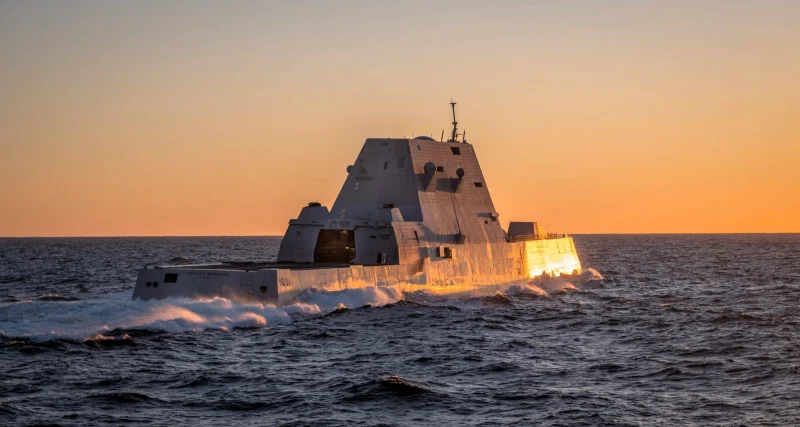
The Navy is refitting the Zumwalt-class destroyers to carry hypersonic missiles, a shift that will turn the stealth ships into long-range strike platforms and keep them at sea longer between port calls. The modernization plan now includes fuel upgrades as well as new weapons.
Documents released recently showed USS Michael Monsoor, DDG-1001, is slated for a Fuel Endurance and Range modification that will convert existing salt water ballast tanks to hold more fuel oil and increase how much fuel the Zumwalt class can take on during replenishment. The changes are meant to boost operational range and endurance for the Navy’s first hypersonic strike platforms, giving them more time to loiter in theater after the work is complete.
Capt. Clint Lawler said the Zumwalt class, with its stealth design and integration of the Conventional Prompt Strike weapons system, will become the Navy’s premier offensive surface combatant. His comments track with a modernization effort that started in 2023 on USS Zumwalt, DDG-1000, at HII Ingalls Shipbuilding in Pascagoula, Mississippi, and later brought USS Lyndon B. Johnson, DDG-1002, to the same shipyard in 2025 for its own conversion.
The missile fit is just as consequential. One former Advanced Gun System mount will house a Large Missile Vertical Launching System with four Advanced Payload Modules, each carrying three hypersonic missiles. Naval Sea Systems Command said the second former gun mount will stay empty for future capabilities, leaving room for a later upgrade if the service decides it needs one.
The shift marks a hard break from the ship class’s original purpose. The Zumwalt was conceived in the 1990s and early 2000s for naval gunfire support, but only three of the planned 32 stealth destroyers were built, and their 155mm cannons proved too expensive to keep armed with ammunition the service could afford. That mission also faded as ground-based anti-ship missile systems spread, pushing the Navy to recast the class for hypersonic strike in response to China and the People’s Liberation Army.
That new role helps explain why range matters as much as firepower. The Navy’s CPS deployment methods are built around stealthy destroyers and future Virginia-class nuclear attack boats, and extending the Zumwalt’s ability to move and wait in theater gives those weapons more reach in a fight. The service’s own logic is now plain: these ships were not just rescued from obsolescence, they were redesigned to deliver the kind of precision strike the fleet says it needs most.
The question now is how quickly the conversions can be finished and whether the three Zumwalt-class destroyers can deliver on the mission they were given after their original one collapsed. If the refits proceed as planned, the class that began as a gunship will emerge as a longer-legged hypersonic weapon carrier built for strategic targets far from shore.
