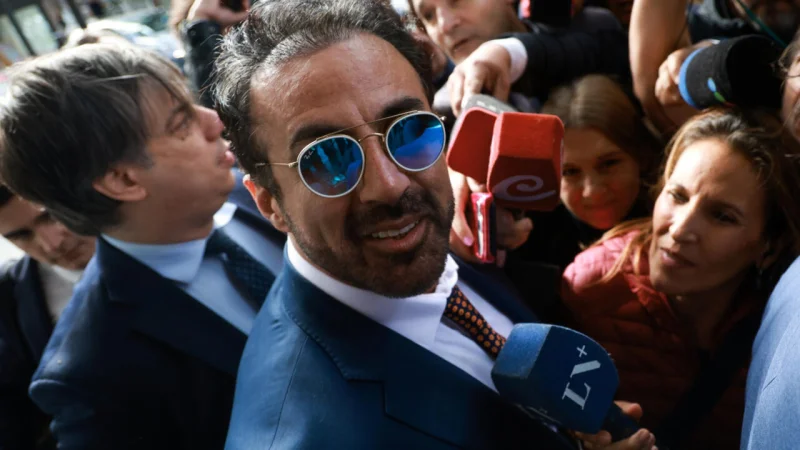
The 13th hearing in the new oral trial over Diego Maradona’s death turned on one question that has shadowed the case from the start: who actually performed his head surgery in early November 2020, about 20 days before he died. On Tuesday in San Isidro, the first witness to appear before judges of TOC N°7 was Pablo Rubino, who said he was called in by the deputy director of Clínica Olivos to help with the operation.
Rubino said Maradona was to be admitted with a subdural hematoma, and that he knew Leopoldo Luque from Hospital El Cruce. Before deciding whether the bleeding could be operated on, he asked for a new tomography. The images, he said, showed a brain displacement of about 6 millimeters. That mattered, he told the court, because from 5 millimeters onward surgery is recommended.
The witness then described the size of the hematoma in stark terms. According to his calculations, the maximum thickness reached 14 millimeters, and once a subdural chronic hematoma exceeds 10 millimeters, the formal recommendation is to evacuate it. Beyond that point, he said, it would not resolve on its own. In his words, the cranium is an inextensible structure that contains 80% brain tissue and 10% blood and cerebrospinal fluid, so any added volume creates a space problem that reduces blood flow and oxygen and shifts the brain.
Rubino’s testimony went straight to the heart of the dispute over the surgery itself. He said Luque proposed forming two surgical teams, one led by him and one led by Rubino, with the latter acting as backup. He added that the first part of the operation, the non-sterile preparatory stage, was carried out by Luque, who was accompanied in the operating room by his partner Ariel Sainz. That account matters because it clashes with what had previously been reported about Luque’s role.
The hearing followed a 2025 null trial in which it was learned that Luque had not participated in the intervention because Maradona’s family did not allow it, and that Rubino performed the operation. The new proceeding is still working through those contradictions, not as a side issue but as one of the central facts in the death case. What happened in that operating room has become inseparable from the wider question of whether Maradona received the care his condition required.
For now, Rubino’s testimony sharpens the picture rather than settles it. He placed the medical recommendation for surgery at the center of the discussion and described an operation shaped by urgency, measurements and divided roles. The next hearings will have to show whether the court accepts that version, or whether the split between who was expected to operate and who actually did so remains one of the case’s lasting fault lines.