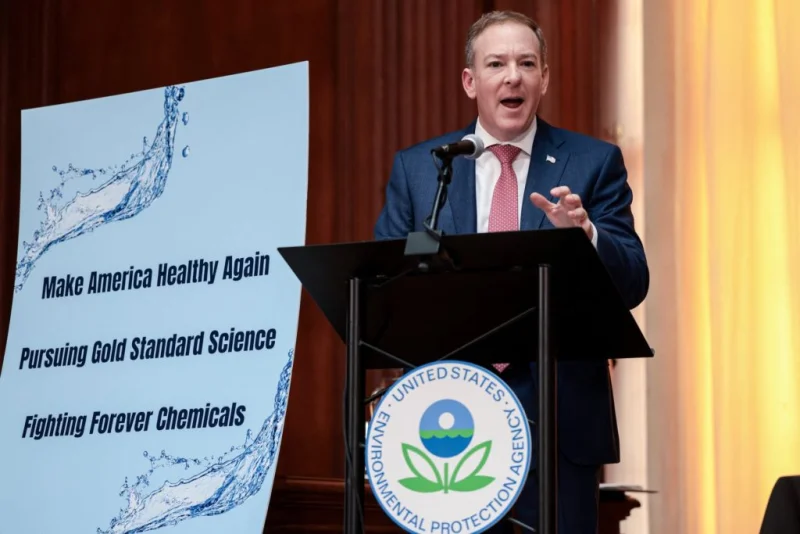
The Environmental Protection Agency said last week it is moving to kill strong Biden-era drinking water limits for four Pfas compounds and delay implementation for two more, even as agency leaders promoted a plan to destroy the chemicals instead.
At an EPA event billed by administration leaders as a Pfas destruction event, Lee Zeldin and Robert F. Kennedy Jr. praised industry leaders and their advances in destruction technology. Kennedy said the plan was built on honest science.
The move lands in the middle of a broader effort by the Trump administration to ditch Pfas drinking water regulations and replace them with a wide-scale push to eliminate forever chemicals after they have already entered the environment. That is a major shift for a contamination problem that reaches far beyond one state or one utility. Pfas are a class of at least 16,000 compounds used to make products water-, stain- and grease-resistant, and they have been linked to cancer, birth defects, decreased immunity, high cholesterol, kidney disease and other serious health problems. They are called forever chemicals because they can persist for thousands of years.
Critics say the administration is promising a fix that does not exist. Kyla Bennett called the idea that it can destroy its way out of the Pfas problem nonsensical. She said no one has shown they can destroy Pfas on a large scale. Her warning goes to the heart of the policy fight: advocates want strong limits and a sharp cut in production, while the administration is betting on technology that, for now, has not been proven at industrial scale.
The stakes are not abstract. Pfas contamination has been found in an estimated 200 million Americans’ drinking water, and the chemicals have also turned up in virtually every recent rain water sample. That makes the EPA rollback more than a technical rule change. It is a decision about whether the country keeps trying to limit exposure at the tap or waits for a destruction system that may never be ready.
For now, the answer is that the limits are being pushed back and the administration is asking the public to trust a cleanup strategy that even some of its critics say remains mostly theoretical.