



Congress left Washington a day early on May 21, 2026, after a revolt by Republican lawmakers burst into the open and exposed how brittle President Donald J. Trump’s grip had become on his own party. The fight centered on Trump’s $1.776 billion slush fund, a plan so explosive that Senate leaders decided not to move ahead with $72 billion in immigration funding rather than force a vote that could drag the controversy onto the floor.
Republican senators spent nearly two hours behind closed doors with acting attorney general Todd Blanche and came out sounding furious. Andrew Desiderio of Punchbowl News said the meeting was incredibly hostile, and Republicans objected that they had received no advance warning about the plan, questioned the legal basis for the fund and bristled at Blanche’s explanation of how payments would work. They said they wanted no part of it. Mitch McConnell put the anger in blunt terms, asking, “So the nation’s top law enforcement official is asking for a slush fund to pay people who assault cops? Utterly stupid, morally wrong—Take your pick.”
The blowback was not limited to one room on Capitol Hill. As many as 25 Republican senators spoke out against the proposal on May 21, 2026, a remarkable show of resistance in a party that has mostly bent around Trump. One Republican senator texted Desiderio, “Our majority is melting down before our eyes.”
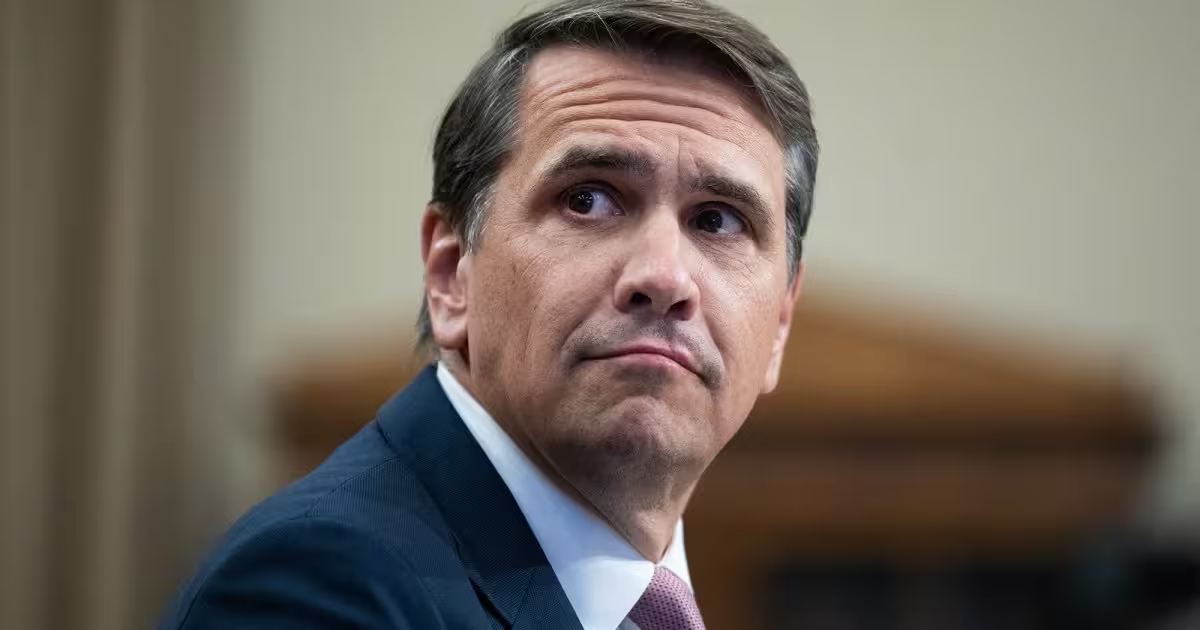
That same day, Scott MacFarlane of Meidas News said senators were asking a deeper question: what was Trump trying to hide by pushing such a controversial fund? He reported that lawmakers were wondering whether the move was a diversion, and his account captured the level of suspicion now hanging over the White House. The irritation had already been building in a party that had seen Trump intervene in Republican primaries to try to knock out incumbents he did not consider loyal enough, feeding a broader sense that loyalty tests were becoming the price of admission.
The money fight also landed on top of another one. Dan Alexander of Forbes reported that Blanche’s tax immunity for Trump could save him more than $600 million, based on an estimated $1.4 billion Trump made in 2025 from crypto and licensing ventures and the $100 million still hanging over him from an earlier tax bill. That added another reason for Republicans to suspect they were being asked to swallow a deal designed around Trump’s personal interests as much as the party’s agenda.
The pressure showed up elsewhere on the Hill as well. House Republican leaders pulled a vote on a measure to stop Trump’s war on Iran under the War Powers Act, and Representative Brian Fitzpatrick said the measure would pass the next time it came to a vote. Senate leaders had already dropped the $1 billion Trump wanted for security for his ballroom from a separate funding measure before deciding to avoid the immigration vote entirely.
The day ended with a party that no longer looked unified, and not just because of one afternoon argument. Trump’s approval rating had fallen to 34%, Republicans were angry about the way he was governing by loyalty test, and Senate leaders were openly choosing to retreat rather than force their members into votes they could not defend. The question now is not whether the fight on the hill will keep going; it is whether Republican leaders still have enough discipline to stop it from spreading.
