


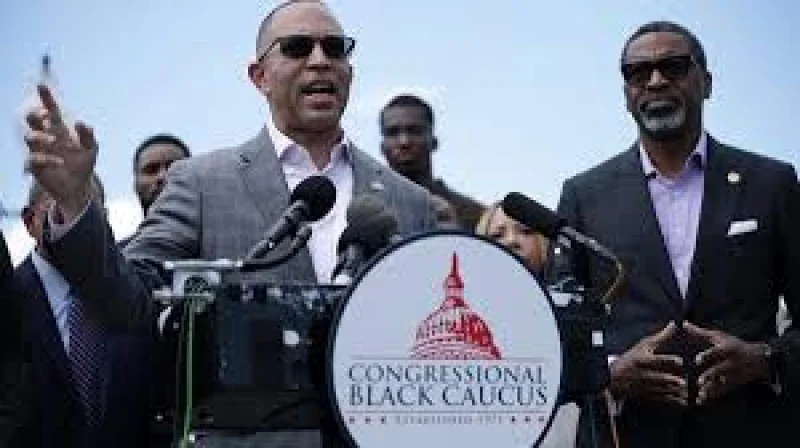
House Democratic leader Hakeem Jeffries called the fight over the Supreme Court’s ruling on racial gerrymandering a Jackie Robinson moment and urged Black athletes to stay away from Southeastern Conference teams. Asked whether he would support a boycott effort, Jeffries said there should be no athletic or sports participation and pressed Black athletes to turn down career-making offers from SEC powerhouse programs.
“You know, this is a Muhammad Ali moment. This is a Bill Russell moment. It’s a Jackie Robinson moment,” Jeffries said. He added that the response would “require a level of courage and character and conviction,” and said existing students should leave SEC schools as part of the protest.
The call came after the Supreme Court’s decision in Louisiana v. Callais, which found racial gerrymandering under the Voting Rights Act unlawful racial discrimination. The move angered Jeffries, who was upset that the court had ended a practice that had been used for decades to guarantee the election of non-white and largely Democratic House members. The NAACP also called for both players and fans to boycott SEC teams after the ruling.
The clash lands inside a long constitutional history the court itself has already shaped. Almost 50 years ago, the justices said racial quotas in university admissions violated the 14th Amendment, and later declared all racial preferences unconstitutional. In 2007, Chief Justice John Roberts wrote that “the way to stop discriminating on the basis of race is to stop discriminating on the basis of race.” Jeffries is now arguing for the opposite kind of pressure: not a courtroom remedy, but a broad social boycott aimed at the South’s biggest sports stage.
The invocation of Jackie Robinson gives the moment its sharpest edge. Robinson played his first year in the Negro League with the Kansas City Monarchs before taking the field for the Brooklyn Dodgers on April 15, 1947, becoming the first African-American player in the Major Leagues. His name has long stood for the end of racial division in baseball, when leagues, quotas and segregation gave way to something else entirely. Jeffries is betting that history still carries enough force to move athletes now.
What happens next depends on whether Black athletes, fans and schools treat the boycott as symbolism or action. Jeffries has made clear he wants action.
