


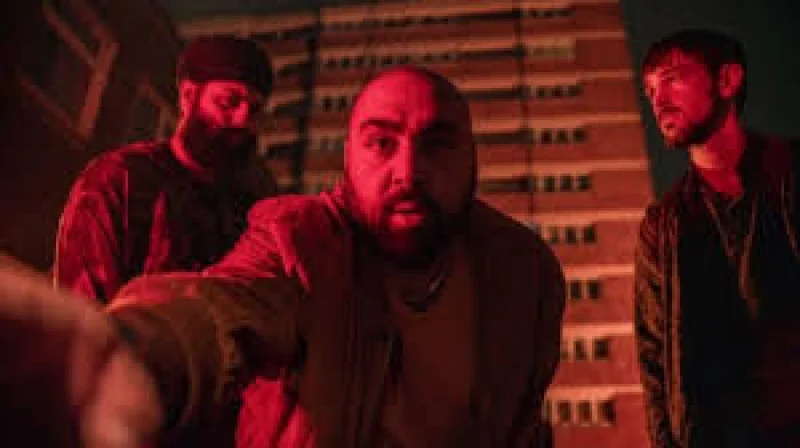
Vengeance: Murder on the Heath is a two-part drama built around the 2011 Honeytrap Murder case, and it wastes no time getting to the point: a friendship that curdled into obsession, then into violence, and finally into a death that still feels hard to process. The production lands somewhere between urgent drama and carefully presented facts, and that balance gives it force.
At the centre is Gagandip Singh, played by Dee Ahluwalia as a prototype influencer and self-made media personality inside Sikh community circles, and Mundill Mahil, played by Sasha Desouza-Willock. Their story begins with attention and approval, but after the sudden death of Singh’s father, his friendship with Mahil becomes a one-sided fixation. Mahil says that at times, it felt like emotional blackmail. Singh turns up unannounced at her student digs in Brighton, tells her he loves her, and later says his car has broken down so he can stay on her couch. When seduction fails, he sexually assaults her. The review argues the violence is fleeting, but its prologue and epilogue are wheedling and desperate, which is what lingers.
That matters because the drama is not just retelling a notorious case. It is asking how a young man who presented himself as socially fluent and admired could slide into coercion, and how those around him read the danger too late. Tajinder Kaur, played by Laila Rouass, suspects from the start that her son is being manipulated by Mundill Mahil, while Ravi Shoker and Darren Peters, played by Ikky Kabir and Badger Skelton, decide to teach Singh a lesson. In the role of the mother, the suspicion is immediate and protective; in the role of the men who intervene, the response is crude and irreversible.
The case was branded the Honeytrap Murder in the tabloid style of 2011, and that label still hangs over the story because it simplifies what the drama keeps showing as something messier. It uses dramatic sequences and straight-to-camera, documentary-style reflections to offer multiple perspectives, and the result feels less like a clean crime of passion than a product of confusion. Aysha Rafaele, who wrote the series and won a Bafta for Murdered By My Father in 2016, keeps the focus on how the situation was seen from inside it, not just how it was later packaged.
That approach is also the show’s sharpest criticism of the old framing. The “Honeytrap” tag implies calculation; the drama suggests pressure, mixed signals and fear, with Singh repeatedly insisting, “That wasn’t me,” and, later, “You know that wasn’t me.” Those denials do not absolve him. They do show how the story was being fought over in real time, long before anyone had the benefit of hindsight.
Joseph Bullman, who executive-produced the series and previously worked on the water industry polemic Dirty Business, helps give the production its sober edge. Vengeance: Murder on the Heath does not pretend the facts are clean, and it does not try to make them feel neat. It is more convincing than that. By the end, the question is not whether the case deserves its notorious label. It is whether that label ever told the truth about what happened at all.
