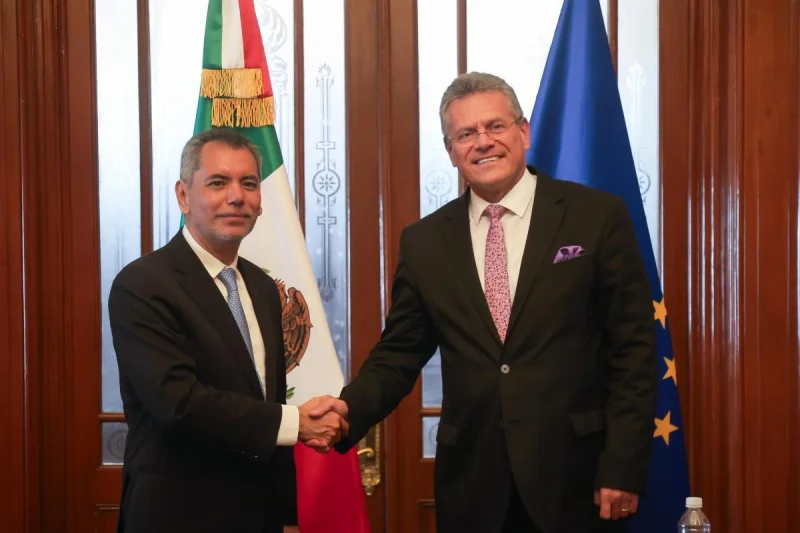
The European Union and Mexico signed a revised trade agreement in Mexico City on Friday, sealing a deal that had been completed in January 2025 but sat unsigned for more than a year.
The pact updates a relationship that has been in place since 2000 and comes as Brussels looks to deepen ties with one of its most important partners in Latin America, alongside Brazil. It also lands at a moment when Mexico is trying to balance trade pressure from Washington, where Canada and Mexico are seeking to modernize the USMCA before a provisional July 1 deadline.
EU foreign policy chief Kaja Kallas set the tone a day earlier, saying the summit would be the bloc’s first in more than a decade and calling it a geopolitical statement at a time when the international order is badly shaken. The signing on Friday turned that language into policy, giving the EU and Mexico a formal opening to expand trade and investment beyond a treaty that had been showing its age.
The numbers show why both sides wanted the update. The EU ships 53 billion euros in goods and 20.3 billion euros in services to Mexico, while Mexico is the bloc’s third-largest trading partner. For Mexico, the agreement arrives as about 80% of its exports still go to the United States, leaving the country exposed to shifts in American trade policy.
A European Commission representative said the delay between the end of negotiations and Friday’s signing was caused by translation and legal review work, describing it as a matter of political timing rather than a breakdown in substance. That explanation may reassure trade officials, but it also underlines how much diplomacy now depends on careful sequencing as governments try to show progress without stirring fresh friction with Washington.
The revised deal is expected to cut tariffs on major European agricultural exports including pork, dairy products, cereals, fruit and pasta. In return, the EU will reduce tariffs on Mexican products including coffee, fruit, chocolate and agave syrup, while protecting 336 additional traditional foods. The Commission said the agrifood sector will be one of the biggest winners from the modernized agreement.
Brussels also plans to present an investment plan under Global Gateway alongside the trade accord, covering energy transition, transport, pharmaceuticals and health, water, agriculture and digital transformation. That package suggests the agreement is being treated as more than a customs update. It is being used as a framework for long-term influence, trade access and industrial cooperation at a time when the EU is trying to harden its economic links beyond the United States and China. For Mexico, the deal offers a broader route into Europe just as it remains heavily tied to the American market.
The timing matters because this is not just a bilateral celebration. The signing came after more than a year of delay, while Mexico and Canada continue to work through the USMCA modernization talks under a provisional July 1 target. That makes the EU-Mexico agreement both a commercial step and a political signal: Mexico is widening its options while the trade environment around North America remains unsettled.