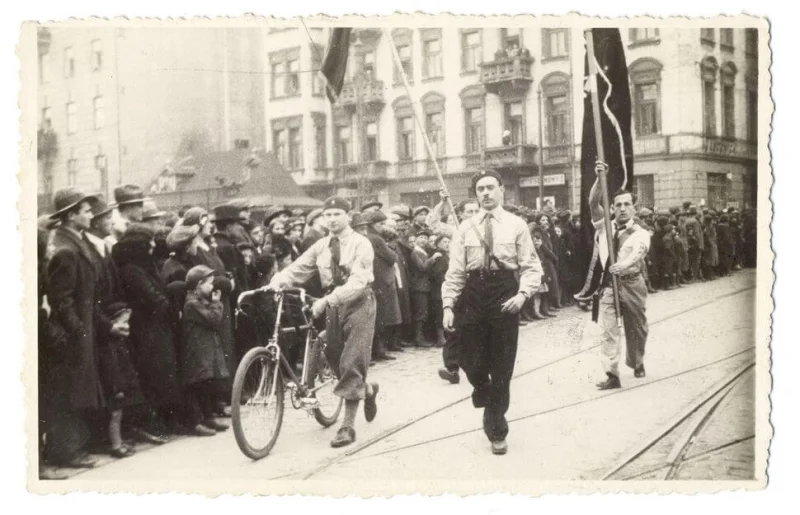
A review published today of Molly Crabapple’s Here Where We Live Is Our Country calls the book a captivating read, even as it says her relationship to historical fact is sometimes loose. The book traces almost 130 years of the Jewish Labor Bund, moving from the Russian revolutions of 1905 and 1917 through World War I, the creation of the Polish republic and the Holocaust.
Crabapple tells that history through the lives of both famous and lesser-known activists, including Vladimir Medem, Arkady Kremer, Raphael Abramovitch, Mark Lieber, Sophie Dubnova-Erlich, Henryk Erlich and Viktor Alter. She also makes her great-grandfather, Sam Rothbord, her guide to the vanished world of Jewish Eastern Europe. Rothbord was born in Volkovysk, now in Belarus, joined the Bund as a young man, later immigrated to America and became an artist. His first exhibit was held at the former headquarters of the Forward on East Broadway.
The review says that choice gives the book its strongest thread. Crabapple reconstructs Rothbord’s life using family photos and papers that were saved, while also comparing his world with her own experiences as an activist on the left. It says she learned Marxist theory from her father, a professor of political economy, and that she explains clearly the differences between the Bund and other leftist parties. In her telling, the Bundists are the good guys, while governments, the Bolsheviks, the Zionists and Western capitalist regimes are cast as the forces responsible for the century’s disasters.
That moral clarity is part of the appeal, but it is also where the review finds its sharpest criticism. It says Crabapple acknowledges that even heroic figures could have difficult personalities, yet she still paints the historical landscape in black and white. The review argues that her treatment of Nicholas I is a key example. Nicholas I died in 1855, long before the percent norm quota was introduced by Alexander III in 1887, and the review says he did not limit the number of Jewish students in Russian universities. It also says Nicholas I never declared that Jews should be forced into a third dying, a third emigrating and a third converting to Christianity, and that he in fact strictly prohibited emigration from Russia.
The review adds that many popular books on Russian Jewish history have attributed that sentence to Konstantin Pobedonostsev, but says no documentary source exists for the claim. That friction between sweeping political storytelling and the record itself is the book’s main fault line. Crabapple’s history is animated by conviction and family memory, but the review’s verdict is that the book is most persuasive when it stays closest to the people it can actually name.