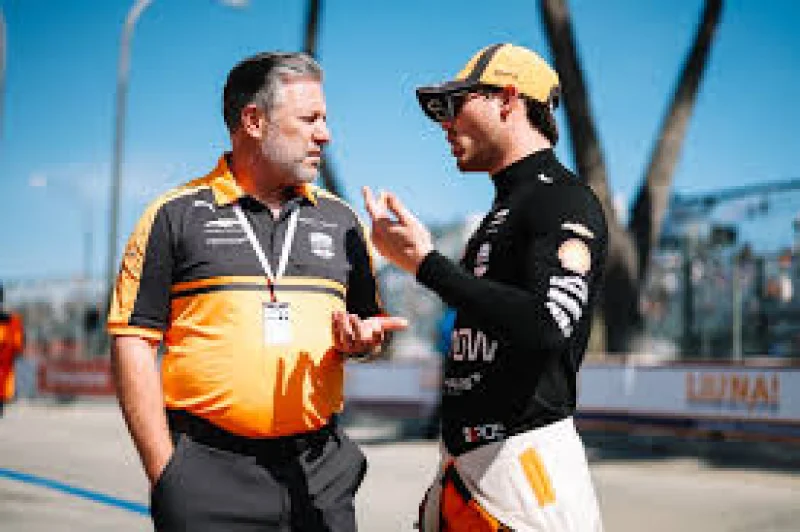
McLaren will send four cars into Sunday’s Indianapolis 500, and Zak Brown says that is part of a wider push to bring the team back to the level it once held at the Brickyard.
The race marks McLaren’s latest attempt to end a 50-year drought at Indianapolis, where it has not won since Johnny Rutherford took the checkered flag in 1976. Brown, McLaren’s CEO since the end of 2016, said Indianapolis remains central to the team’s identity. “Indianapolis is kind of a second home,” he said. “The racing that I grew up with was Indy car racing.”
Pato O’Ward will go into his seventh Indy 500 on Sunday with McLaren again leaning on him as one of its strongest chances. The Mexican driver has finished close before, including in 2024 when Josef Newgarden beat him late after O’Ward came within two corners of winning the race. He enters this year’s event after a 2025 season in which he won twice and finished second in the standings, while Christian Lundgaard arrived at Indianapolis Motor Speedway with his first IndyCar victory for McLaren two weeks ago on the road course.
O’Ward described the build-up as part of the job rather than a burden. “It’s all positive,” he said, adding that the experience has been “either a learning curve or some of the greatest memories that I have in my career.” He said the challenge is part of the appeal: “There are just challenges that you need to accept when you sign up for this.”
McLaren’s path back to prominence at Indianapolis has been uneven. Brown’s first major move into the race came in 2017, when the team entered Fernando Alonso in a one-off effort with Andretti. Three years later, McLaren bought into Schmidt Peterson Motorsports. The team then hit one of its lowest points in 2019, when it failed to qualify with Alonso. Brown said the broader rise across McLaren’s racing operation has changed the mood, pointing to the team’s Formula One turnaround that culminated in both world championships last year.
Brown, who lived in Indianapolis for 20 years, said the city still feels familiar. The company is also trying to reconnect with its own past, when McLaren was viewed as an American racing powerhouse in the 1960s and 1970s. On the eve of another Indianapolis 500, that history is no longer just nostalgia. It is the standard McLaren is chasing again.
Rutherford, now 88, called McLaren’s return to a fuller Indianapolis presence “perfect.” He said, “I’ve been there and done that, you know,” and added that the current run gives him a chance to relive it. “It’s an opportunity to relive it, and to enjoy the team company and the team.”
For McLaren, Sunday is not only about one race. It is about whether four cars, a revived program and a familiar venue can finally turn a long effort into something that looks a lot like the old McLaren again.