


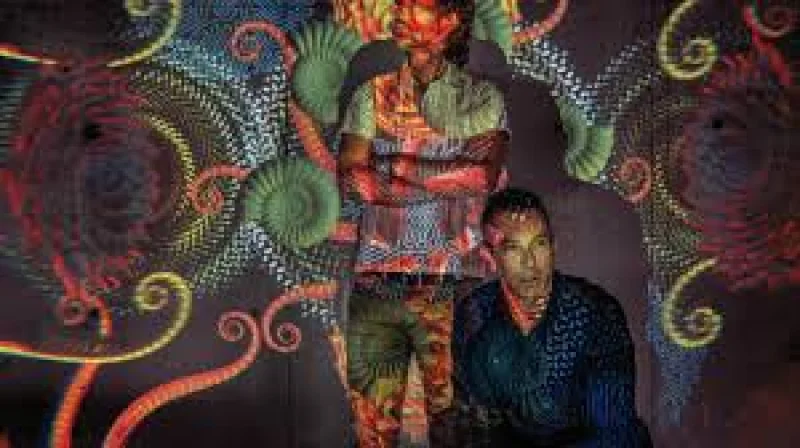
Vivid Sydney will switch on on Friday with 22 drone shows, 1,000 drones and a harbour-front program that will run for 22 nights. The festival’s lights will sweep across Circular Quay, The Rocks, Darling Harbour, Barangaroo, the Sydney CBD, the Sydney Opera House and Carriageworks, with more than 80 per cent of the program free to attend.
The drones will write swirling galaxies, Fibonacci spirals and luminous nebulas into the night sky, part of a festival that is leaning hard into scale and spectacle. The Light Walk will also be shorter and uninterrupted this year, stretching 6.5 kilometres through the city’s illuminated core, making it easier for visitors to move between the major installations without breaking the flow of the night.
That scale matters because Vivid has built its reputation on turning Sydney itself into the venue. This year, the harbour front is the anchor, and the program folds in a mix of landmark pieces and site-specific work designed to pull crowds along the waterfront rather than scatter them across the city. For visitors, the draw is not just the number of events but how tightly they are stitched together.
One of the headline installations will be French artist Yann Nguema’s Opera Mundi, which will light up the Sydney Opera House sails in honour of Jørn Utzon. Another will be TIME:WARPED, a seven-minute projection across the 50-metre-long Argyle Cut using 12 projectors. The show combines lasers, haze and projection into a format the festival says has never been delivered for Vivid before.
Heath Campanaro, who worked on the Argyle Cut piece, said the team wanted the work to feel immersive rather than as a simple image on stone. “We really wanted to be immersive as opposed to just projecting onto a surface,” he said. He pointed to the site’s layered past as part of the concept, describing it as “hundreds of thousands of years of rock that’s been cut through to create that tunnel” with visible strata, convict stories and a history of dangerous crime-gang activity that helped shape the idea for the work.
The Argyle Cut itself was carved from 1843 by convict chain gangs as a shortcut across the narrow peninsula between The Rocks and Millers Point, and in the late 1800s it became associated with cutthroat crime gangs. Campanaro said that mixture of geology and history gave the team its direction. The finished piece stretches the projection down the walls and adds haze and lasers to create what he called a high-energy club vibe, adding that the result is “cool, and bloody beautiful.”
The creative team behind the Argyle Cut show also has a strong festival pedigree. NeonDynamo, which created content for Glastonbury Festival’s iconic Pyramid stage screens, is behind the Vivid projection, bringing a concert-scale visual language into one of Sydney’s oldest urban spaces. That link helps explain why the work feels more like a performance than a static display.
Antony Partos, meanwhile, summed up the emotional territory the festival is willing to explore this year. “Melancholia, tension, satire, requiems – that’s my happy place,” he said. It is a useful guide to a program that is not trying to be all glow and no edge.
Steve Kamper called the Argyle Cut a “standout addition to this year’s program, inviting visitors to step into a world of light, sound and illusion that captures the creativity and innovation Vivid Sydney is renowned for.” The description fits the scale of what is coming, but the more important point is practical: with over 80 per cent of the program free, Vivid is pushing for broad access while still reserving room for the kind of headline moments that can define the festival. For anyone planning a night out in Sydney, the question is not whether there will be enough to see. It is how much of the city they will be able to cover before the 22 nights are over.
