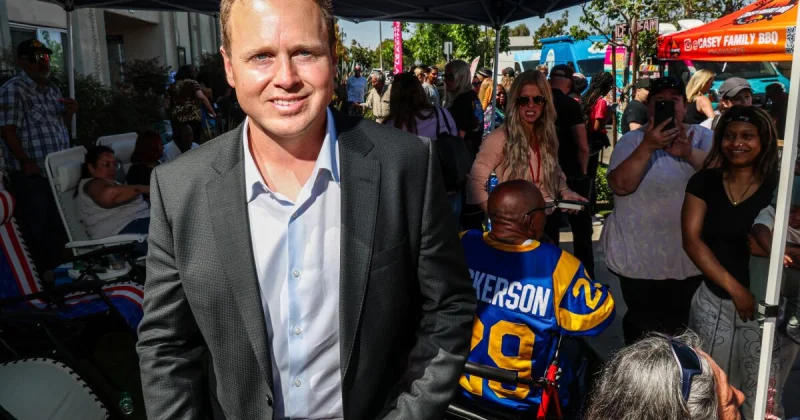
Spencer Pratt says he is running for mayor of Los Angeles to save the city, not to make money or raise his profile, and he used an interview with Eyewitness News to make his case by attacking the city’s response to homelessness. Asked by Josh Haskell about the more than 40,000 homeless people in Los Angeles, Pratt answered bluntly: “Well, they’re not homeless. They’re drug addicts.”
He said most people on the street are addicted to fentanyl and meth, and argued there are already places in Los Angeles for them to sleep. In his view, people remain outdoors because they want to use drugs, avoid rules and refuse to listen. He also said they want animals to abuse, a remark that underscored the hard edge of his campaign message.
Pratt’s comments came in the same interview in which he said he had gone to Washington and seen miles of prefabricated housing and buildings, then asked company executives how long they took to make. He said he also met with FEMA and HUD, and that the housing could be built in three days on federal land. He said that when he is mayor he would go back to the federal government to get the property, though he would not give an exact address while he is only a candidate.

The pitch is tied to a broader argument about money and management. Pratt said he would rather be promoting his book, his wife’s music or his crystal business, but cannot do so while following campaign ethics rules. He also said he lost his home in the Palisades Fire and added, “I’ve never had struggles. I had choices.” Then he drew a line between his own money and public funds: “Let’s be clear, my money, not taxpayer money.”
Pratt framed the city’s housing effort as a matter of waste, not a lack of resources. He pointed to Los Angeles Mayor Karen Bass and said she spent $400 million to house 1,400 people. He said he could hire 10 better accountants to make sure the city does not waste money and argued that a tighter grip on spending would matter more than another round of promises. The city’s total budget is $15 billion, a scale that gives his critique political weight even as it raises the question of how much a mayoral outsider can realistically change.
That is the friction running through Pratt’s campaign: he is making sweeping claims about homelessness, shelter and federal land, but it remains unclear how he plans to carry out all the goals he is campaigning on. His proposal leans on personal certainty and public anger, not a detailed roadmap. For now, the answer to whether the Los Angeles bid is a protest candidacy or a serious governing plan depends on whether Pratt can turn broad attacks into something more concrete than a set of headlines.