


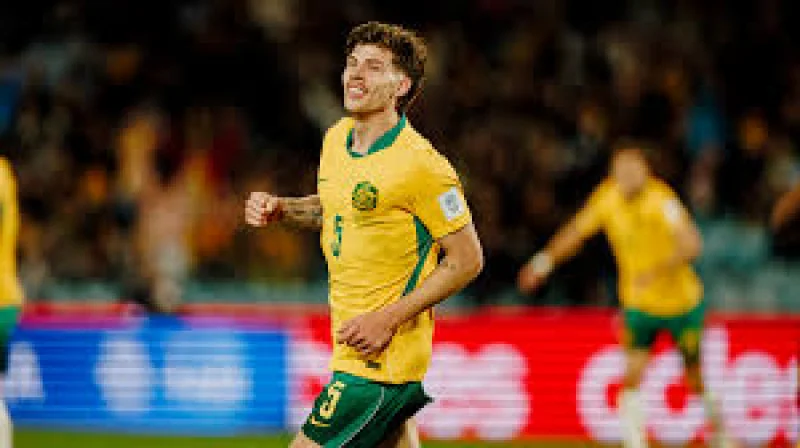
Mo Touré will go to the World Cup with a burden that would test any 22-year-old striker. The Norwich forward, born in Guinea after his family fled Liberia, has scored nine goals in 11 Championship matches since joining the club in January, and is set to carry the Australia national football team’s attack in North America next month.
For Touré, the chance means more than selection. “It will mean a lot to me and my family,” he said, adding that Australia is “the country that gave us the opportunity to live, so I think it will be the best way to repay back, and just do what I love at a top level.”
He is not the only young forward from an African refugee background shaping the Socceroos’ future. Nestory Irankunda, 20, who was born in a Tanzanian refugee camp after his parents escaped Burundi and now plays in the Championship with Watford, said Touré’s scoring run “is not an easy achievement.” Irankunda has already said the squad have enough quality to produce a surprise, telling Channel 10 before he left for the United States that he felt the Socceroos could go all the way. “We’ve got to wait and see what happens, but I feel like we can go all the way,” he said.
The rise of Touré and Irankunda sits inside a broader change in Australian football. Andrew Howe said 12 players with African heritage have played for the Socceroos in the past five years. Two decades ago, the equivalent five-year period produced just one, Patrick Kisnorbo, whose father is Mauritian. The most recent player with African heritage mentioned in the article was Lucas Herrington, whose father is from Zimbabwe.
Australia’s African-born population is now more than 500,000, and the Australian Bureau of Statistics says it has more than doubled in the past 20 years. South Africa accounts for close to half of that population, while there is also strong growth among people born in Nigeria, Ethiopia, Congo, South Sudan and Kenya. The numbers help explain why the pathway into the national team looks different now than it did a generation ago.
That change has been felt especially in South Australia, where footballing talent has grown out of a diverse African community. Awer Mabil, 30, was born in Kenya to South Sudanese parents, progressed through junior football in Adelaide and now plays for Castellon in Spain’s second division. He is on the brink of Socceroos selection and said Irankunda’s development has stood out. “The biggest thing I’ve seen is his attitude has really matured,” Mabil said. “Sometimes he’s disappointed that he’s not starting, which is normal for you to feel down as a player. But I try to tell him, it’s all about how you respond. Whatever you can’t control, don’t focus on that.”
Bruce Djite’s path reflects a similar thread. Born in the US to a father from Côte d’Ivoire and a Togolese mother, he moved to Sydney when he was three before later settling in Adelaide and going on to play nine times for the national team. His career, like Mabil’s, shows how widely Australia’s football talent has spread beyond the old pathways that once fed the Socceroos almost alone.
The immediate task is simple and difficult at once: turn that growing depth into goals at a World Cup. Touré is likely to lead the line, Irankunda is pushing to add another weapon, and Australia will arrive in North America next month with a squad that looks more globally connected than any in recent memory. Whether that mix is enough to change the team’s ceiling is now the question hanging over its attack.
