


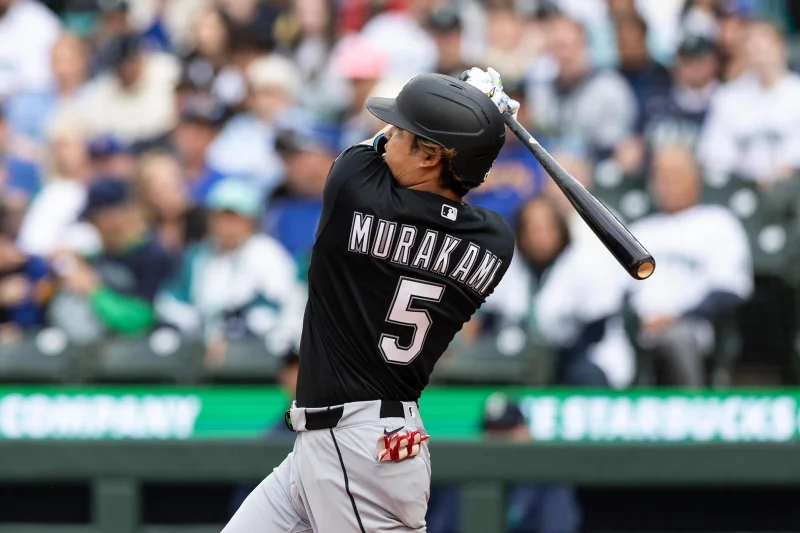
The White Sox opened a three-game series against the Giants on Friday night at Oracle Park, and they did it on Japanese Heritage Night with Munetaka Murakami once again in the middle of the conversation. Chicago arrived with a 16-10 record over its last 26 games, the kind of stretch that has made a once-unlikely club harder to dismiss.
That run has overlapped with a month in which Murakami has hit.253/.372/.526 in 113 plate appearances, with 24 hits, eight home runs, two doubles, 18 walks and 38 strikeouts. He has 17 homers on the season, trailing only Schwarber, and his 18.4% walk rate ranks fourth-best in MLB behind Nick Kurtz, Taylor Ward and Mike Trout.
That is the part that matters most for the white sox vs giants series: the player who was described in the winter of 2026 as having “Phenomenal cosmic power – itty bitty contact rate” has started to answer the doubt with production, even if the contact questions have not vanished. A month before this series, Ben Clemens and FanGraphs revisited the issue and wrote that if Murakami never became more than the quality-of-contact hitter seen over the previous three years, with no real changes or improvement, he could not be a good major league hitter.
The numbers behind that argument were not subtle. Murakami’s 32.5% strikeout rate on the season is 7th-worst in the sport, and his 38 strikeouts in those 26 games were part of the same profile that has made him such a hard player to slot cleanly into any projection. Even with the damage he is doing when he connects, the swing still carries real risk because the whiffs remain baked into the package.
That tension is what gives Friday night’s series a little more weight than a normal West Coast opener. The Giants were expected to be better than the White Sox, and Chicago’s relevance has been revived in part by the arrival of a fun player from Japan. At the same time, the White Sox are still carrying the memory of two seasons built by Chris Getz that combined for 223 losses, which is why every decent stretch now gets treated as something more than a blip.
The immediate question is not whether Murakami has made the criticism disappear. It is whether the version of him that has helped keep Chicago alive over the past 26 games is stable enough to travel beyond one hot stretch, on a stage built for attention and under the pressure of a team that badly needs more than a tease.
