


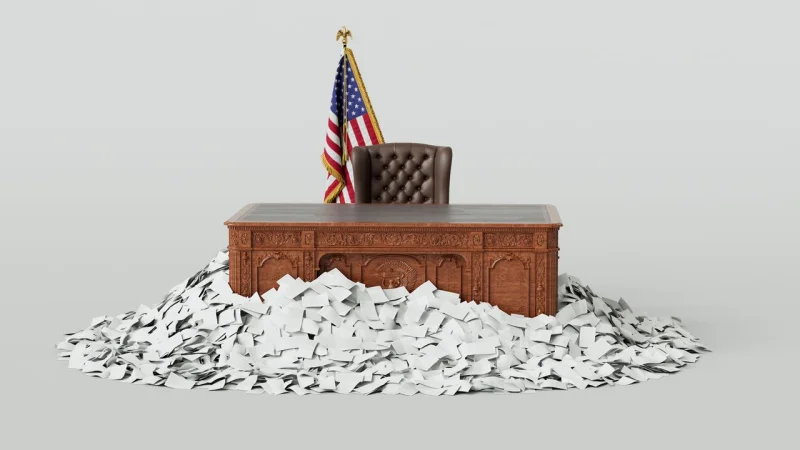
Donald Trump spent years fighting the idea that his presidential papers belonged to anyone but him, and that old habit is back in court. A federal judge on Wednesday heard arguments over whether the White House must keep following the Presidential Records Act while lawsuits press to force compliance with the law.
The fight is not abstract. Trump has long chafed at demands that he preserve records, and during his first term he developed a habit of tearing documents into tiny pieces after he was finished with them. White House employees had to tape some of those papers back together for archiving, and his lawyers and White House counsel urged him to stop. Maggie Haberman wrote in her 2022 book, Confidence Man, that he would periodically throw print paper into the toilet during that period. When National Archives officials pressed for the return of records, Trump replied: “It’s not theirs; it’s mine.”
That posture now meets a law enacted in 1978 after Watergate and the battle over Richard Nixon’s White House tapes. The statute says a president’s official records are government property, must be preserved while he is in office and turned over to the National Archives when his term ends. An earlier version passed in 1974 applied only to Nixon. The law was meant to make sure the public could eventually see the documentary record of a presidency, not leave it to the president’s own judgment.

Last month, the Justice Department’s Office of Legal Counsel went in the opposite direction. At the request of David Warrington, it issued an opinion declaring the Presidential Records Act unconstitutional. The office said Congress cannot preserve presidential records merely for the sake of posterity and argued that the law intrudes on “the constitutional independence and autonomy of the Executive.” It concluded that the president need not further comply with the statute’s dictates.
That opinion immediately triggered new litigation. Two lawsuits were quickly filed to require the White House to follow the law, one brought by the American Historical Association and American Oversight, and another by the Freedom of the Press Foundation and Citizens for Responsibility and Ethics in Washington. In the first case, the groups said, “This case is about the preservation of records that document our nation’s history, and whether the American people are able to access and learn from that history,” warning there is “a clear danger that official government records of the highest importance will be irretrievably lost.”
U.S. District Judge John Bates heard the case on Wednesday on a request that he order the administration to comply with the records law while the litigation moves ahead. The hearing lands in the middle of a larger record-keeping fight that Trump has been involved in before and that has only grown more consequential since boxes from the White House containing classified material were found crammed into a bathroom at Mar-a-Lago, next to a toilet and below a crystal chandelier. He was later investigated by special counsel Jack Smith and charged with improper retention of classified documents, though the case was eventually dismissed by U.S. District Judge Aileen Cannon on the ground that Smith had been improperly appointed.
What this means now is straightforward: the administration is not just testing a statute, but the basic idea that presidential records are public property once the presidency is over. If Bates grants the request for immediate compliance, the White House must keep the law in place while the broader constitutional fight proceeds. If he does not, the case will move forward with Trump’s own Justice Department opinion hanging over a law that has governed presidents since the aftermath of Watergate.
