


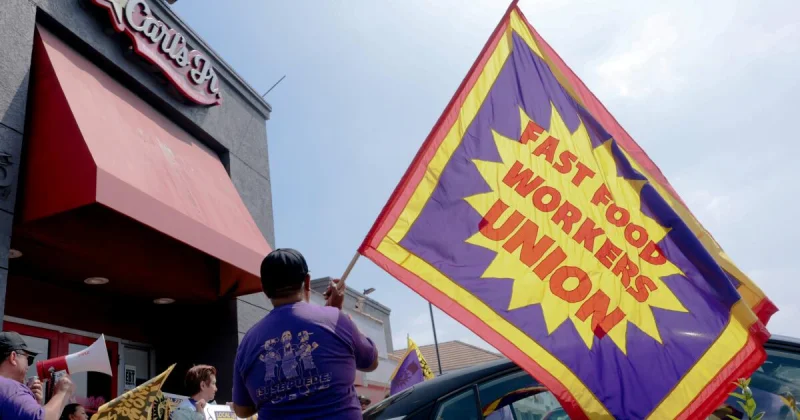
Carls Jr. started as a hot dog cart in 1941 and grew into one of the biggest fast-food names in California. Today, one of its largest franchisees is fighting to keep 59 outlets open after filing for bankruptcy protection last month.
Harshad Dharod, who controls the stores, blamed the filing on California’s $20 minimum wage for fast-food workers and on what he called a lack of innovation at the chain. The franchisee said the distress was driven by a sharp rise in labor costs after state law established the $20-an-hour wage, a burden that hit a company with close to 1,000 employees and almost all of its restaurants in Southern California.
The filing lands at a difficult moment for the chain, which first opened sit-down restaurants with expanded menus in Anaheim in 1946 and later bought Hardee’s in the 1990s before moving its headquarters from Carpinteria to Tennessee in the last 10 years. Carl’s Jr. has spent years trying to hold its ground in Southern California, where high operating costs, fierce competition, labor unrest and crime have all pressed on the brand at once.
“These guys were first at the party in Southern California,” Chris Rodriguez said. “Now, it’s kind of like they’re swimming upstream in every lane.” That sense of strain has shown up in the stores themselves, where workers in North Hollywood described violent interactions with customers, including robberies and physical assaults, and some employees said the company refused to provide safety training.
Elizabeth Alvarado, one of those workers, said the problems begin well above the counter. “It’s a problem from the top. They don’t want to spend,” she said. “I need my job, and I do the best I can. But, I can only do so much.” Her comments reflect a broader reality for a brand that is still operating but under visible pressure, even as its franchisee’s stores remained open as of mid-May.
CKE Restaurants, which owns Carl’s Jr. and also runs Hardee’s with similar menus and branding, said the filing was limited to one operator. “This situation is specific to this individual franchisee’s financial and business circumstances,” a company spokesperson said. “We remain committed to delivering quality experiences for our guests, while driving profitable, sustainable growth for our franchisees and brand.”
For Carl’s Jr., the bankruptcy is not just a balance-sheet problem. It is a warning that in California, even a chain with deep roots and long name recognition can be forced to choose between higher wages, higher security concerns and a business model that no longer has much room to absorb either.
