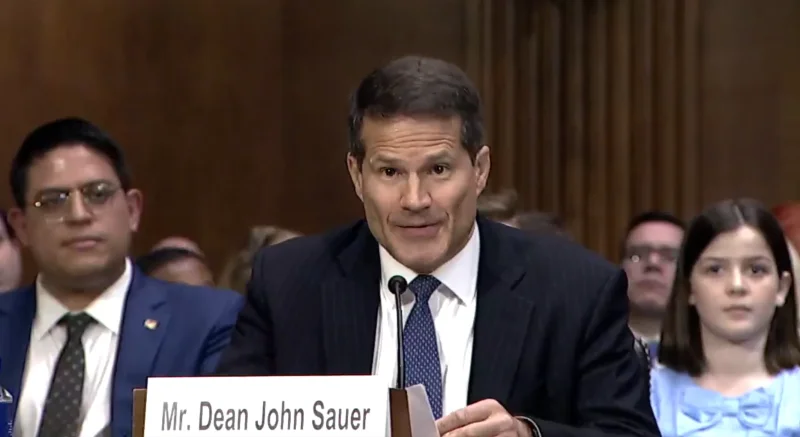
D. John Sauer, the 49th solicitor general of the United States, has become one of the most consequential legal figures in Washington as the Supreme Court weighs major disputes over presidential authority, immigration policy and the reach of federal power. A former Missouri solicitor general and appellate lawyer for Donald Trump, Sauer now represents the federal government before the justices in cases that could define the second Trump administration’s legal boundaries.
Sauer’s Role Puts Him At The Center Of Federal Litigation
The solicitor general is often called the federal government’s top Supreme Court lawyer. The office decides which cases the United States brings to the high court, which lower-court rulings it asks the justices to review and how the administration’s legal positions are framed in constitutional disputes.
Sauer assumed the role on April 4, 2025, after Senate confirmation on a 52-45 vote. His appointment placed a longtime conservative appellate advocate in one of the most powerful legal posts in the executive branch, with direct responsibility for defending the administration’s agenda before a Supreme Court that has repeatedly been asked to resolve high-stakes disputes involving Trump policies.
The office is traditionally expected to balance presidential priorities with the federal government’s long-term institutional credibility. That tension has become especially visible under Sauer because many of the administration’s cases involve emergency requests, aggressive assertions of executive power and challenges to nationwide court orders blocking federal policies.
From Missouri Solicitor General To Washington
Before joining the Justice Department’s senior ranks, Sauer served as solicitor general of Missouri from 2017 to 2023. In that role, he handled major appellate litigation for the state and became associated with conservative legal challenges involving federal authority, election disputes, religious liberty, regulatory power and social policy.
His résumé also includes work as a federal prosecutor, private appellate practice and elite legal credentials. Sauer graduated from Duke University, studied at Oxford as a Rhodes Scholar, earned a graduate degree from Notre Dame and received his law degree from Harvard. He later clerked for Judge J. Michael Luttig and Justice Antonin Scalia, two influential conservative legal figures.
Those credentials gave him a strong foundation in appellate advocacy before he became nationally known for representing Trump in litigation tied to presidential immunity. His arguments in that case helped put him in the center of the debate over how far criminal liability can reach into official presidential conduct.
Trump Connection Shapes Scrutiny Of The Office
Sauer’s prior work for Trump has made his tenure more closely watched than that of many past solicitors general. Supporters view him as a skilled advocate with deep constitutional experience and a clear command of conservative legal arguments. Critics argue that his close association with Trump raises concerns about whether the office can maintain its traditional independence and credibility with the court.
That debate intensified during confirmation and has continued as the Justice Department has brought a series of urgent disputes to the Supreme Court. Sauer’s defenders say the solicitor general is doing what the role requires: presenting the administration’s legal positions forcefully and seeking quick relief when lower courts block national policies. Opponents say the office has become unusually aggressive in asking the justices to intervene early and often.

The result is a solicitor general whose arguments are being watched not only by lawyers and judges, but by political officials, advocacy groups and voters interested in the balance of power between the presidency and the courts.
Birthright Citizenship Fight Raises Stakes
One of Sauer’s most closely watched arguments involves birthright citizenship, a constitutional issue rooted in the 14th Amendment. The administration has argued for limiting automatic citizenship for some children born in the United States to parents who are unlawfully present or in the country temporarily.
The case carries enormous legal and practical implications. Birthright citizenship has long been understood as a central rule of American nationality law, and any substantial change would affect families, immigration enforcement, state agencies and future litigation over citizenship status.
Sauer’s role is to present the government’s position while answering questions from justices concerned about text, history, precedent and consequences. The dispute also places the solicitor general in the middle of a larger ideological fight over immigration, executive authority and the meaning of post-Civil War constitutional guarantees.
Emergency Appeals Test The Court’s Limits
Sauer has also represented the administration in emergency matters involving deportation policy and other federal actions blocked by lower courts. These cases often move quickly, with the government asking the Supreme Court to pause injunctions before full appeals are completed.
That strategy reflects the administration’s broader view that single federal judges should not be able to halt national policies for extended periods. The counterargument is that emergency relief can allow sweeping government action before courts fully examine whether it is lawful.
For the solicitor general, emergency litigation presents a high-risk test. The office must persuade the justices that immediate intervention is justified without appearing to treat the Supreme Court as a routine workaround for lower-court defeats. How Sauer manages that line may shape the court’s view of the administration’s credibility over the rest of Trump’s term.
A Legal Role With Political Consequences
Sauer’s rise shows how the solicitor general’s office can become a central force in national politics, even though its work is conducted through briefs, oral arguments and court filings rather than campaign speeches. The cases he handles will influence immigration rules, presidential power, agency authority and the ability of lower courts to restrain executive action.
The immediate question is how the Supreme Court responds to Sauer’s arguments in the administration’s most consequential cases. The longer-term question is whether his tenure changes expectations for how aggressively a solicitor general should defend a president’s agenda.
For now, D. John Sauer is not just the government’s lawyer at the Supreme Court. He is the administration’s chief courtroom advocate in a term where the legal limits of presidential power are being tested case by case.