


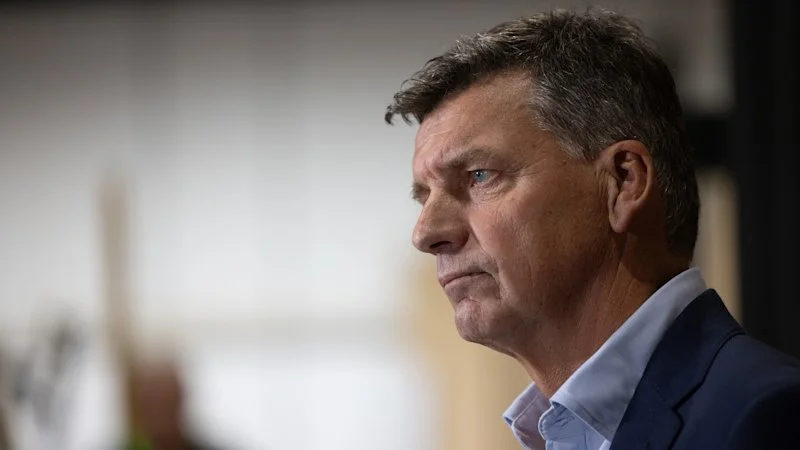
Angus Taylor has pledged to cut net overseas migration by just 5 per cent if Labor meets its own forecasts for weaker migration and stronger housing supply by the next election. The opposition’s citizenship and migration push would cap arrivals at the number of new homes completed in Australia, tying one of the country’s sharpest political fights to the pace of construction.
Taylor said in his budget reply speech that he would deliver one of the most significant immigration cuts in history. But he has not put an exact number on the target, saying the Coalition would need to judge how many homes were being built closer to the election. Under the government’s current projections, net overseas migration is expected to fall to 225,000 in 2027-28 while housing completions reach 213,000, leaving a gap of 12,000.
That arithmetic matters because net overseas migration measures long-term arrivals minus departures, and the number surged after borders reopened following the COVID-19 pandemic. Arrivals peaked at more than 555,000 in 2023, far above the pre-pandemic level of about 225,000. Taylor is using that peak as the benchmark for a far more aggressive reset, billing the policy by one measure as a 70 per cent cut that would take net overseas migration closer to 166,000.

The Coalition’s pitch lands while the government is already under pressure on both migration and housing. Last week’s budget showed it would miss this year’s migration target by 35,000 and had increased its expected intake. Labor is also at least a year behind its aim of building 1.2 million homes by 2029, and its projections rest on 4 per cent boosts to supply even as the Reserve Bank of Australia expects dwelling investment to slow.
There is also friction inside the opposition’s own ranks. Shadow ministers were not brought into the loop on most of the changes announced in Taylor’s speech, and Liberal backbencher Andrew McLachlan on Tuesday could not say the policy had been endorsed by the partyroom beforehand. McLachlan accused his side of stoking anxiety and fear in the community and alienating migrants with its rhetoric, a warning that the debate over citizenship, migration and housing is already spilling beyond policy into politics.
Opposition housing spokesman Andrew Bragg defended the plan on Monday and dismissed the government’s forecasts. He said he would be surprised if Labor ever built 200,000 homes in a year, let alone the 250,000 needed to close the gap Taylor is proposing to use as a cap. A spokesman for Taylor said Labor had left a 400,000 person shortfall by building enough homes for 1.4 million people over the same period the population had grown to 1.8 million.
Former Department of Immigration deputy secretary Abul Rizvi said Labor did not have enough in its policy platform to hit its migration projections. He also warned that cutting net overseas migration too far and too fast could damage the local housing market. That leaves Taylor’s proposal in a narrow space: politically potent because it answers voter anxiety over housing, but dependent on forecasts both sides already dispute. If the numbers do not move as Labor expects, the Coalition’s ceiling on migration may end up defined less by policy than by the building sites that never materialized.
