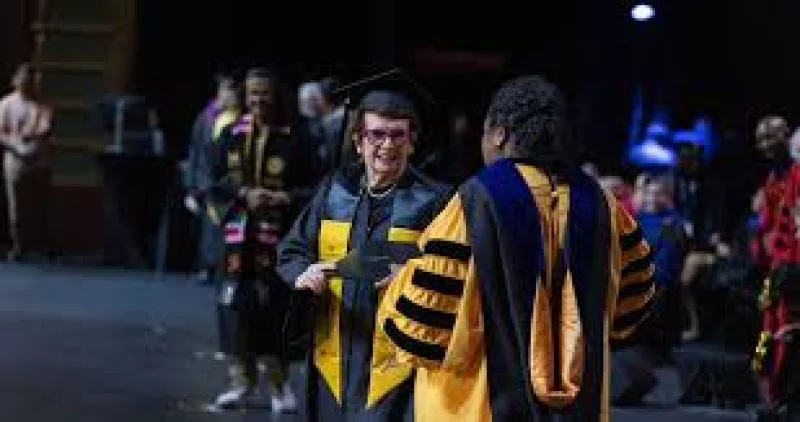
Billie Jean King walked across the stage at California State University, Los Angeles on Monday and received the bachelor’s degree in history she first started in 1961. She was 82, wearing a golden stole that read “student athlete” and “G.O.A.T.,” when she accepted her diploma from university president Berenecea Johnson Eanes.
Before taking the diploma, King hit tennis balls from the stage to fellow graduates, a small flourish from a woman whose name has long been tied to the sport. She paused her studies in 1964 to chase tennis full time, then spent the next six decades building one of the most decorated careers in the game.
King learned a little over a year ago that she was just one year short of finishing the degree she had begun while first enrolled at what was then Los Angeles State College. “I went, ‘Three years [done]? Oh, I’m going back for sure,’” she said of deciding to finish. She took remote classes to complete the remaining work, with coursework that ranged from historical research and writing to historiography. One assignment brought her back to one of the most important causes of her career: she had to write an essay on Title IX.
That law was part of the broader shift King helped push for in sports and beyond. She was involved in helping get Title IX passed, and she later founded the WTA Tour, helping shape the professional era for women’s tennis and adding pressure to a sports landscape that had given women far fewer opportunities than men.
The timing of the degree also carries its own weight because of what King accomplished after leaving campus. While first enrolled in college, she won her first Wimbledon doubles title. Her career ultimately produced 39 Grand Slam titles, including 12 singles championships, 16 women’s doubles titles and 11 mixed doubles titles. She won a record 20 Wimbledon titles across all disciplines, and in 1973 she swept the singles, doubles and mixed doubles titles at Wimbledon in one tournament before later that year beating Bobby Riggs in the “Battle of the Sexes” match in Houston.
The tension in the scene on Monday was not whether King had earned the degree. It was how long it had taken for the formal record to catch up with a life that had already changed tennis. Now the diploma sits alongside a career that was already complete in the eyes of fans, rivals and institutions alike.