


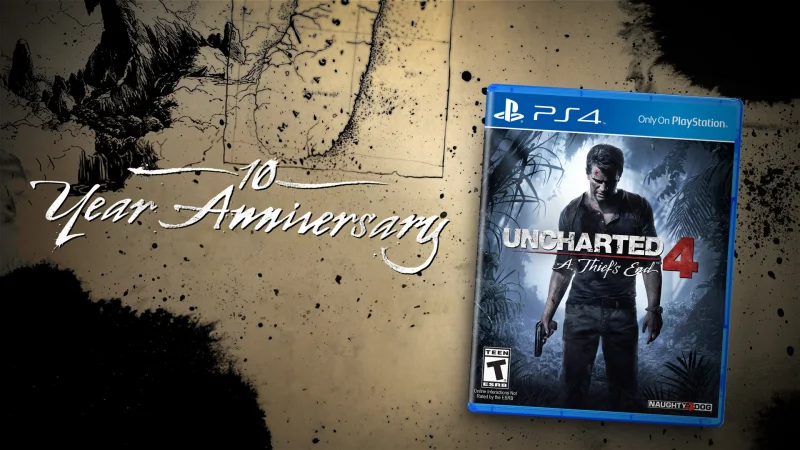
Naughty Dog shipped Uncharted 4: A Thief's End 10 years ago, and the game still reads like a statement about what a blockbuster adventure could be. A decade later, it remains one of gaming's best pure adventure romps, a rare title that asks players to enjoy the chase instead of apologizing for it.
The clearest proof is in the way it plays. The grapple hook is the obvious mechanical highlight, but Uncharted 4 is built around more than one trick: the auction house heist, the Madagascar chapter where Nathan Drake drives a 4x4 through semi-open muddy terrain while hunting artifacts, and the crumbling clocktower that bleeds directly into a convoy chase through King's Bay. Even the rooftop flashback with the Drake brothers escaping their Catholic school gives the series its shape: a little reckless, a little romantic, and always moving.
That is why the game's place in the PlayStation lineup still matters today. It arrived after years in which Naughty Dog would go on to make The Last of Us Part 2, a technical and narrative achievement, and after God of War Ragnarok, one of the most polished action games ever made. Those games are bracing in their own right, but they belong to a prestige lane where bleakness is often the dominant flavor. Uncharted 4 points the other way. It wants momentum, banter, and spectacle.
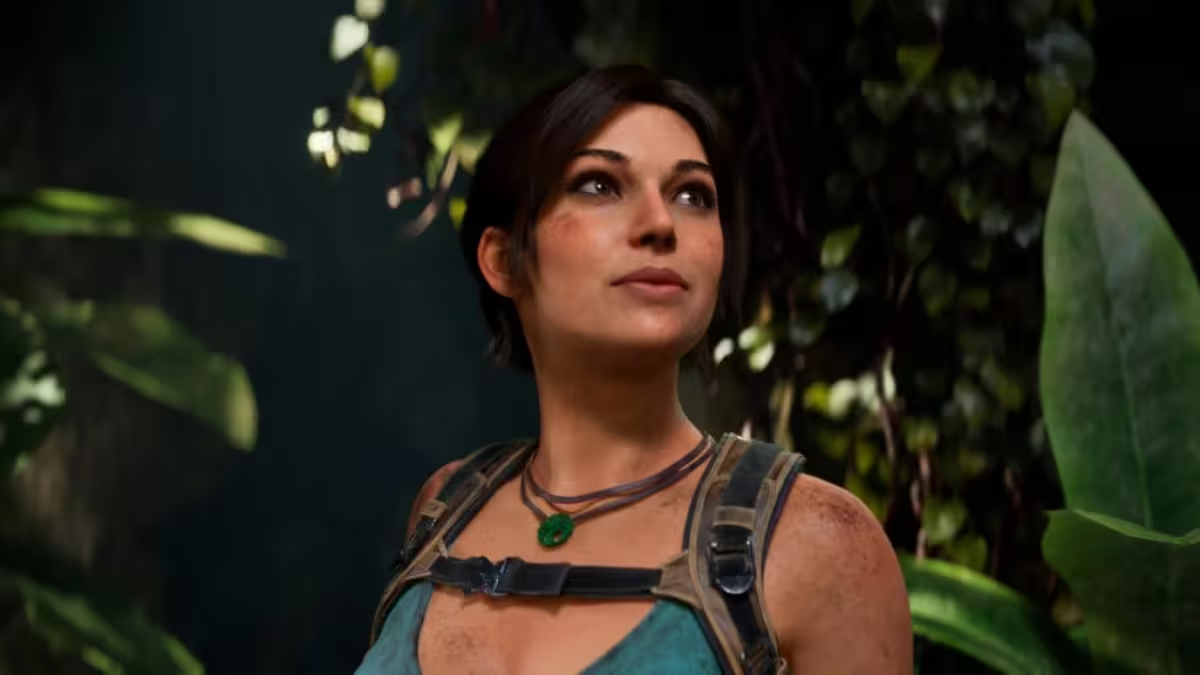
The contrast becomes sharper when the series is set beside the Tomb Raider reboot trilogy, which ran parallel to the Uncharted PS3 and PS4 era and pushed Lara Croft further into trauma and brutality. Uncharted never fully surrendered to that mood. Its world has danger, loss, and ruined treasure, but the mood is closer to a studio ride than a survival slog. As games.gg put it, “The game wants you to feel like an action hero, not a survivor.”
That difference explains why the series still leaves a gap that later PlayStation hits have not really filled. Uncharted: The Lost Legacy arrived in 2017 and shifted the lead role to Chloe Frazer and Nadine Ross, but it also underlined how unusual the core formula was in the first place. A decade after launch, the original game still stands as a benchmark for fun-first adventure gaming, and the genre gap it leaves behind is more visible than ever. That is not hyperbole.
The answer to whether Uncharted 4 still matters is yes, because it preserved a kind of mainstream action game that has become harder to find. Ten years on, it is still the one that runs toward the set piece, not away from it.
