


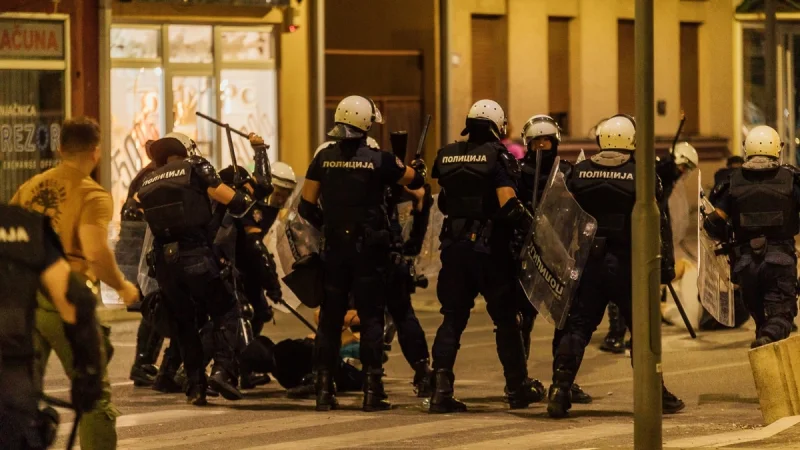
Hundreds of people gathered in Valjevo on Thursday to mark nine months since police cracked down on protesters in the western Serbian town, as anger over the authorities’ failure to punish those blamed for a deadly railway station canopy collapse again spilled into the streets.
The crowd marched to the local police headquarters behind a large banner reading “Valjevo remembers.” A student protester asked who the officers were who beat children and citizens on the streets of Valjevo, saying it had been nine months since 14 August and that accountability remained missing. Sixteen people died when a concrete canopy fell at a newly renovated railway station in northern Serbia in November 2024, and the Valjevo protests were tied to that case.
The anniversary came as two doctors who examined some of the injured said the injuries were consistent with severe beatings. Djordje Alempijevic and Slobodan Nikolic assessed 25 people after the August 2025 crackdown, at the request of the injured or their lawyers. One man had bruises across his back, torso, arms and legs, with injuries Alempijevic said were consistent with being struck with a baton at least 28 times. Valjevo hospital reports pointed to the same type of bruising, while additional bruising on the neck may have been caused by fists or feet.
Alempijevic said the injuries were spread “essentially all over his body” and that the most common wounds in Valjevo were caused by police batons. Those injuries were mainly to the back, lower back, flanks, buttocks, thighs and upper arms, while abrasions to elbows, knees and forearms were also frequently recorded. He said those abrasions were typical of contact with the ground or being dragged across it. In some cases, the doctors documented nose fractures, kidney contusions and extensive muscle tissue damage.
“This was not just the conclusion of my examination,” Alempijevic said, adding that reports from Valjevo hospital pointed to the same bruising pattern. He said the patterns indicated that in a significant number of the cases reviewed, force had a punitive rather than purely controlling character. One of the injured men said in written testimony that he was struck repeatedly while lying on the ground and then again at the local police station. The police did not respond to a request for comment.
Serbian Interior Minister Ivica Dacic has said police officers “attack no one” and that if they are attacked, they defend themselves. That defence sat uneasily beside the injuries described in Valjevo and the testimony from people who say they were beaten after being pinned down. Alempijevic, who said he has also investigated reports of torture used against protesters in Belarus, and Nikolic were commissioned to examine the victims because of the injuries they suffered. Their findings now place fresh pressure on a government that has so far not answered the core question raised again on Thursday: who ordered, and who carried out, the force used on 14 August in Valjevo?
