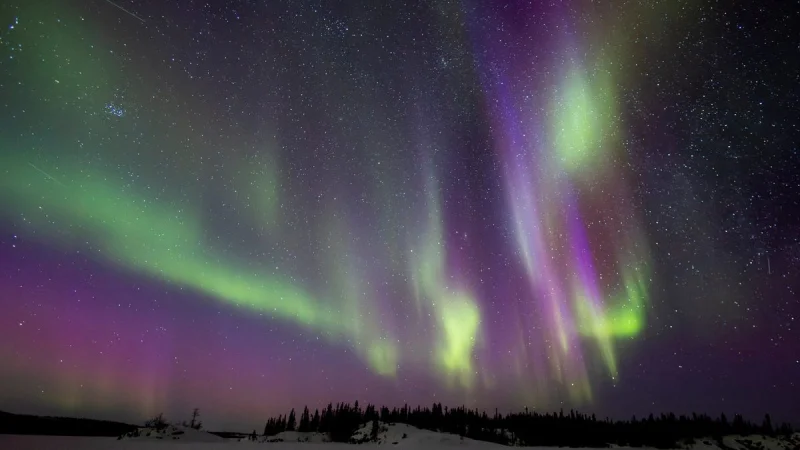
More Americans across several states may get a few chances to see the northern lights this weekend, with the aurora already visible in some light viewing on the night of May 14 and another round expected late Friday into Saturday morning. The display could return again later Saturday night into Sunday, according to a forecast from the National Oceanic and Atmospheric Administration's Space Weather Prediction Center.
NOAA said the lights could be visible from Friday, May 15, through Sunday, May 17, with the best viewing generally between 10 p.m. and 2 a.m. The agency added that the timing can shift by location and as weather and visibility forecasts change, but the 11 p.m. to 2 a.m. window remains the best bet for Friday night into Saturday morning. Geomagnetic activity is expected to peak at different times over the three days, with a G2 storm likely to flare between 5 p.m. and 8 p.m. ET on Friday evening and a similar setup on Saturday, when a geomagnetic spike is forecast around 8 p.m. ET.
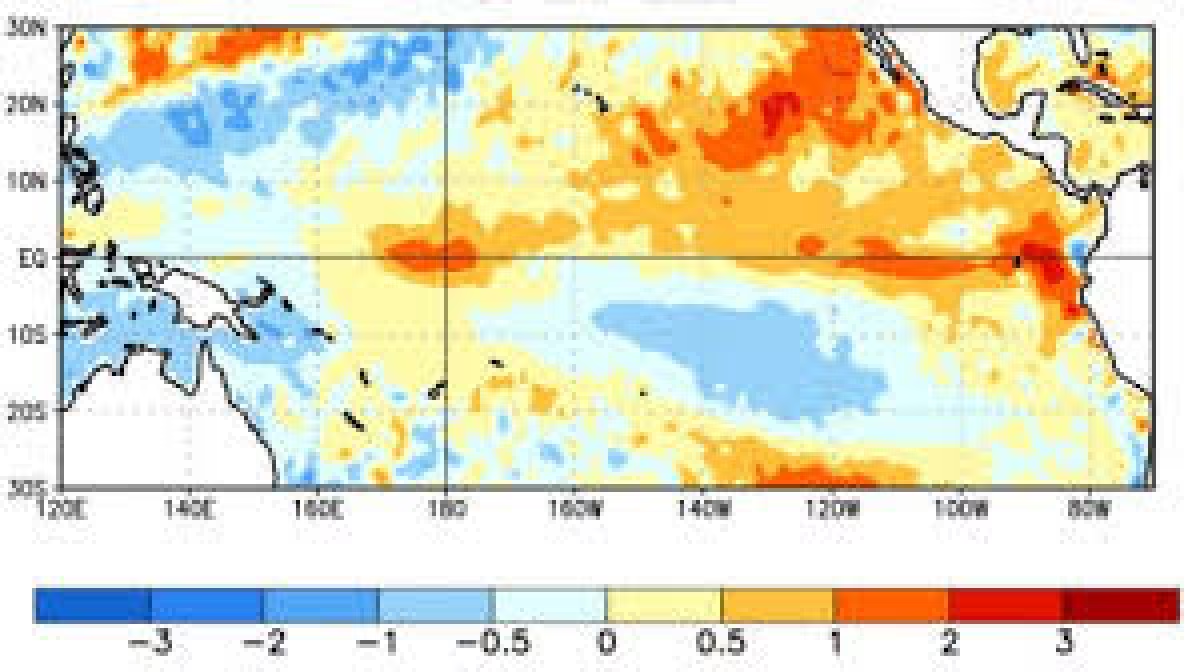
The weekend forecast matters because it stretches the possibility of a sighting across three nights instead of one. NOAA's afternoon forecast on Friday called for mild to moderate activity to continue through the weekend, and the agency said Canada is getting the best, most intense viewing this time around. For people farther south, the chance is narrower: the states on NOAA's forecast map and the Farmers' Almanac list would have at least a glimpse during a G1 storm, while a stronger G2 event could push the lights farther south. A G3 storm is considered unlikely, but if it happened, the auroras could reach as far south as Pennsylvania, Ohio, Indiana, Nebraska, Wyoming and California.
The northern lights are the luminous glow seen around the magnetic poles of the Northern and Southern hemispheres. In the Northern Hemisphere, they are called the aurora borealis. The Southern Hemisphere has its own version, the aurora australis. For this weekend, the key question is not whether the sky can glow, but which places get a clear enough, dark enough window when the geomagnetic activity peaks.