


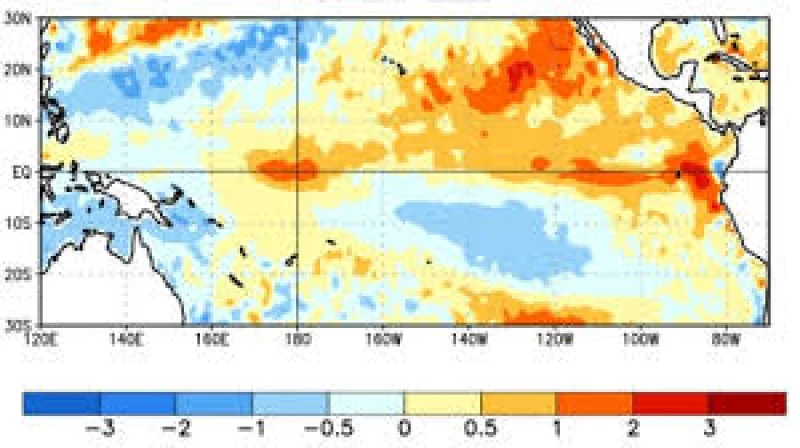
El Niño is likely to return soon, and U.S. forecasters say it could be strong enough to shape weather on two oceans during the coming hurricane season. NOAA's Climate Prediction Center said on May 14 that there is an 82% chance the pattern will emerge in the next two to three months and a 96% chance it will last through December 2026 to February 2027.
The forecast matters because El Niño can change the balance of hurricane activity even before it fully settles in. NOAA said the pattern favors stronger hurricane activity in the central and eastern Pacific basins while suppressing activity in the Atlantic basin, where it usually increases wind shear that makes storms harder to organize. In the Pacific, the same pattern can reduce wind shear and support more storms.
The timing puts the forecast squarely against the June-November hurricane season, when any shift in ocean temperatures and upper-level winds can alter how many storms form and where they intensify. NOAA said El Niño could still be strong enough during that period to affect storm formation in both the Atlantic and Pacific Oceans. Michelle L’Heureux said there is a 2-in-3 chance of a strong or very strong El Niño during the November 2026 to January 2027 season, a sign that forecasters think the event could deepen later in the year.

El Niño is a natural climate pattern in which surface waters in the central and eastern tropical Pacific run warmer than average. The broader cycle is known as El Niño-Southern Oscillation, or ENSO, and its cooler counterpart is La Niña. The pattern has been watched for centuries; fishermen off the coast of South America recognized it in the 1600s by unusually warm Pacific water around Christmas.
The global consequences can reach far beyond the oceans. The World Meteorological Organization says El Niño events typically warm the global climate and are associated with heavier rainfall in parts of southern South America, the southern United States, the Horn of Africa and central Asia, while bringing drought to Australia, Indonesia and parts of southern Asia. The agency also said 2024 was the hottest year on record because of the combination of the powerful 2023-2024 El Niño and human-induced climate change from greenhouse gases.
The tension in the outlook is that the forecast is only a best estimate, not a fixed outcome. L’Heureux said the odds will shift in the months ahead depending on how conditions evolve, which means the coming hurricane season may still be caught between an emerging El Niño and the atmosphere’s response to it. For forecasters, the next question is not whether El Niño will matter, but how much of the season it will have left to shape.
