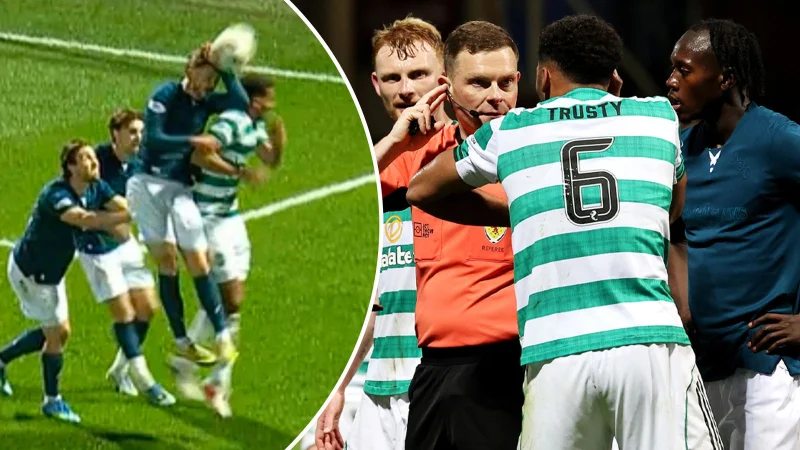
Celtic were awarded a late penalty to beat Motherwell at Fir Park on Wednesday evening, after a VAR intervention that has reignited fury over the system in Scottish football. The decision came after Scotland’s dedicated VAR official, Andrew Dallas, alerted referee John Beaton, who took a brief look before pointing to the spot.
Gary Lineker did not hold back. Reacting to the call, he said: “This might be the worst VAR decision I’ve seen (and there’s a lot of competition),” before adding: “Extraordinary given the significance.” His criticism landed in the middle of a match that turned on one of the most debated decisions of the season and left Motherwell with little chance to recover.
The key moment came when Motherwell’s Sam Nicholson leaped for the ball alongside Auston Trusty. Nicholson’s elbow was catapulted upwards by Trusty’s shoulder, and the ball likely touched Nicholson’s hand before VAR stepped in. That sequence was enough for Dallas to send Beaton to the monitor, and the final call handed Celtic the penalty that decided the game.
The significance of the incident goes beyond one result. Fir Park on Wednesday evening is being treated as a watershed moment for VAR in Scottish football, because Celtic’s win against Motherwell has become another reason cited by critics who want the system gone. The debate has already been simmering around the SPFL, where the matchgoing experience has been fundamentally undermined by video reviews and where attendances are still reported using ticket sales rather than the people actually in seats. Wednesday’s call gave that anger a fresh target.
The scale of the crowd underlined the frustration. A reported 18,113 were tied to the match in official figures, but the argument around VAR has long been about more than one number. Supporters want the game to feel immediate and trustworthy; instead, they got a late intervention, a short review and a decision that has been described in brutal terms by one of football’s most recognisable voices.
That criticism is not happening in a vacuum. In 1990, Lineker played for Tottenham in a 1-1 draw at Tynecastle, and he has seen enough football to know when a call is going to dominate the conversation. His response to this one suggested that the argument has moved well past frustration and into open disbelief.
The wider issue is what happens next. Scottish football is now tangled with the video assistant referee system in a way that few expected when it was introduced, and Wednesday’s decision will only deepen the pressure on those defending it. For Hearts, the fallout may be even more immediate: the article said the incident may prove fatal in their push to make history, a reminder that one late call in one match can reach far beyond the teams on the pitch.