


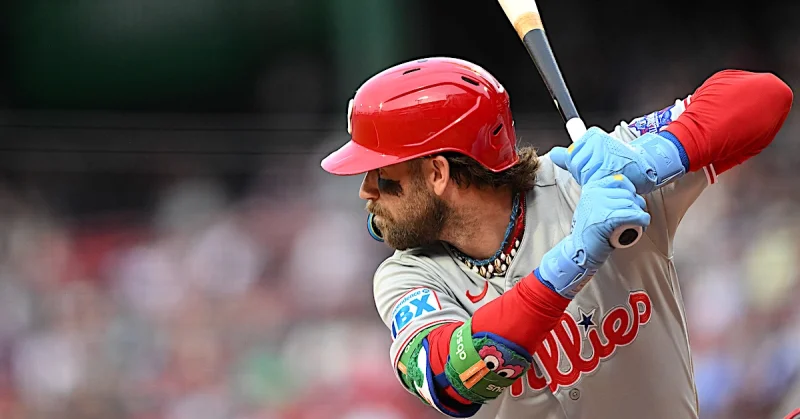
Bryce Harper has spent the first 43 games of 2026 answering the questions that followed him out of a rough 2025, and the early returns are loud. He has 10 home runs, his highest wRC+ since 2021, and a stat line that looks much more like the star Philadelphia expected than the player who finished last season with his lowest wRC+ since becoming a Phillie.
Harper, 32, also had his least fWAR in a season in which he played at least 130 games since 2016 and posted his lowest slugging since that same year. But through 43 games in 2026, the numbers have moved back the other way: his strikeout rate has dropped from 20.9% in 2025 to 16.9% this season, his slugging is up 45 points, and he already has 20 extra-base hits. That is the kind of start that changes the tone around a player quickly, especially after a season that raised real doubts about where his game was headed.
Dave Dombrowski addressed those concerns at the Phillies’ end-of-2025 season press conference, when Harper’s downturn was being weighed as a possible sign of decline. The production so far in 2026 gives a different reading. It is not just the power. Harper’s average swing speed is roughly the same as it was in 2025 and 2024, his 90th percentile exit velocity is nearly identical to previous seasons, and his sprint speed has stayed the same. Those are the kinds of markers teams look at when they are trying to separate age-related erosion from a bad stretch at the plate.
The friction point is that some of Harper’s approach numbers have become more aggressive, not less. His chase rate is 35.9%, and his first pitch swing rate is 51.4%, which suggests he is still willing to attack early and often. He is also living with some uneven contact results. His BABIP is at its lowest since 2016, which helps explain why the overall line does not look even better. Against 95-plus mph pitches, though, the picture is sharper: Harper’s whiff rate is 12.3%, and his projected slugging against that velocity is 94 points higher than his actual slugging in 2026. That gap says the bat speed and quality of contact are still there, even if the results are not perfectly matching them every night.
That is why the first six weeks of this season matter beyond the box score. Harper is not producing like a player slipping out of his prime; he is producing like one whose 2025 line was the outlier. The Phillies do not need a theory about his decline today. They have 43 games of evidence that says the opposite.
