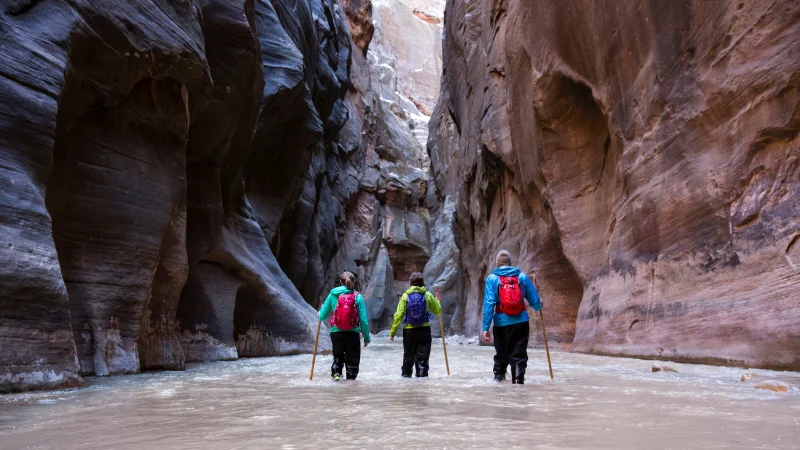
When Jamie Aranoff last went to Zion National Park with her family during a passing heat wave, they skipped Angels Landing and chose the Narrows instead. Aranoff, her brother and her parents waded into the park’s iconic slot canyon and hiked almost the entire 9-mile round trip to Big Springs and back.
“It’s definitely one of my favorite hikes ever,” Aranoff said of the route through the 1,000-foot-deep canyon walls. “It’s so fun and unique.”
The Narrows is one of the most recognizable hikes in zion national park, but it is not as simple as stepping into shallow water and walking upstream. Aranoff said people often underestimate the route because it looks like little more than a wade, yet the river can move hard enough to shove hikers backward with each step when the water is high. She said she had to hold her pack over her head a few times during a June hike, a reminder that conditions can change quickly even on a trail that draws visitors in part because it offers relief from summer heat.
That June visit came with a different kind of lesson: gear matters. Closed-toed shoes are mandatory in the Narrows, but Aranoff said she would have preferred neoprene booties. Sneakers, she said, get heavy once they are soaked, and every step becomes a fight against the weight dragging at the feet. The park’s outfitting culture has grown around that reality. Just a few minutes from the entrance, visitors can rent booties, wetsuits and other gear at Zion Guru before heading into the canyon.
The route also comes with rules that fit its narrow walls and wet ground. Hikers are not allowed to leave human waste in the Narrows. Guides generally tell people to pee directly into the river if they cannot wait until the trailhead, and WAG Bags are a must for number two. The leave-no-trace guidance is part of the same reality that shapes the hike itself: in a confined canyon, what works on a regular trail does not always work here.
Aranoff said the risks are manageable if hikers are honest about what they can handle. “They’re super knowledgeable, and they won’t scare you in the wrong direction if you’re honest about your fears and your abilities,” she said of the people helping visitors prepare. That advice matters because the Narrows is not always the same hike twice. In late summer, water levels are often low enough for easy wading, but some years hikers have to swim through deeper sections. Big Springs remains the traditional turnaround point and the farthest point hikers can reach without a wilderness permit.
For Aranoff, that mix of beauty, discomfort and uncertainty is exactly the appeal. The Narrows offers a rare chance to move through Zion’s canyon walls from the inside, but it rewards only the hikers who come prepared for current, cold water and soaked shoes. In the end, the hike she remembered as a family outing in a heat wave is also the one that best captures why the Narrows has become the park’s signature challenge: it is scenic enough to draw people in, and serious enough to demand respect.