


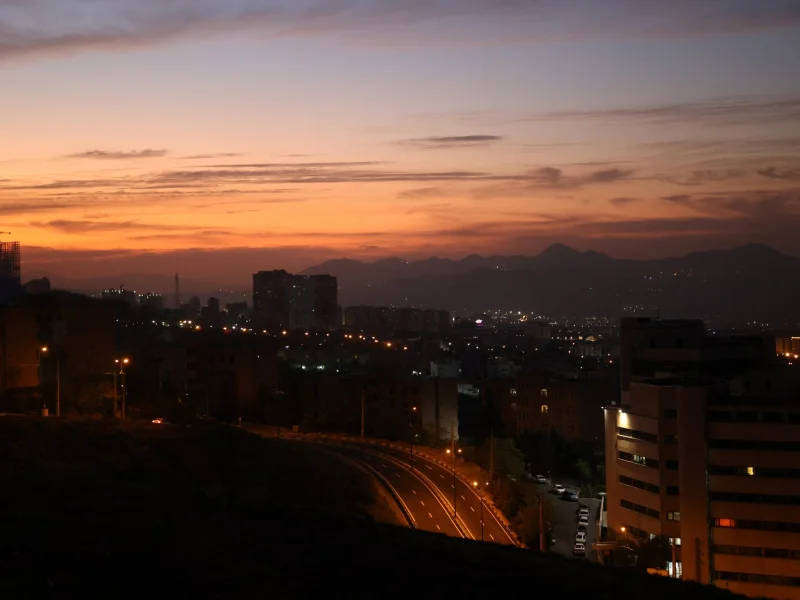
Tehran was rattled overnight Tuesday by a string of earthquakes that began with a 3.4-magnitude tremor and grew into a 4.6-magnitude quake later in the night, while a powerful dust storm swept through the capital of Iran at the same time. Several aftershocks followed into early Wednesday morning, sending some residents into parks, streets and their vehicles as the city waited out the shaking.
Authorities said the quakes caused no casualties or major damage, but the storm did at least injure seven people and left parts of the city dealing with severe dust, outages and fallen trees. The back-to-back jolts and the storm gave Tehran a sleepless night and revived memories of how quickly daily life can tip into panic in a city where the ground beneath eastern neighborhoods and nearby towns sits on an active fault line.
Geologists say that fault stretches at least 200 kilometers and is capable of producing earthquakes above magnitude 7, with a major event expected roughly once every century. Nearly 200 years have passed since Tehran’s last truly destructive quake, the magnitude 7.1 event that devastated the city in 1830. Since then, smaller tremors have repeatedly reminded residents of the danger beneath them, including the December 2017 quake, when a 3.5-magnitude tremor triggered widespread panic.
Fariborz Nateghi Elahi, a geologist quoted in the discussion around the city’s seismic risk, said, “We know an earthquake will happen.” He added that it will not be “on this scale, but something much, much larger.”
The contrast between fear and routine was visible in the way people reacted this week. One social media user recalled that the 2017 earthquake sent Tehran residents sleeping in cars, gridlocking streets and packing gas stations, even though it was only a 3.5-magnitude quake. This time, the response was far quieter, a sign of how repeated shocks have worn down nerves in a city that has lived for generations with the prospect of a catastrophic strike.
For some, the dust storm itself was the first alarm. One woman said, “The storm started, windows were shaking, and I thought: ‘Is it fighter jets?’” After the earthquake followed, she said, “Then the earthquake came, and I thought: well, that’s nothing. Compared to war, everything feels like a joke.” Her reaction echoed a broader mood among many residents whose sense of danger has been shaped as much by recent air and missile attacks during two wars as by the ground moving under their feet.
Tehran’s night of shaking came against a harder backdrop as well. More Iranians are moving back in with family or taking on roommates after losing jobs and struggling to keep up with rising rents in major cities. One citizen said he lost his petrochemical company job and moved back into his parents’ house with his wife and two children. A woman who had been supporting her household alone said she was forced to share her home after losing her restaurant job. For a city already under economic strain, even a night of no major damage can still feel like one more reminder that stability is fragile.
The earthquakes did not bring the destructive event many in Tehran have long feared, but they did show how close that fear remains. The fault beneath the city is still there, pressure is still building, and the next serious quake is not a question of if, but when.
