


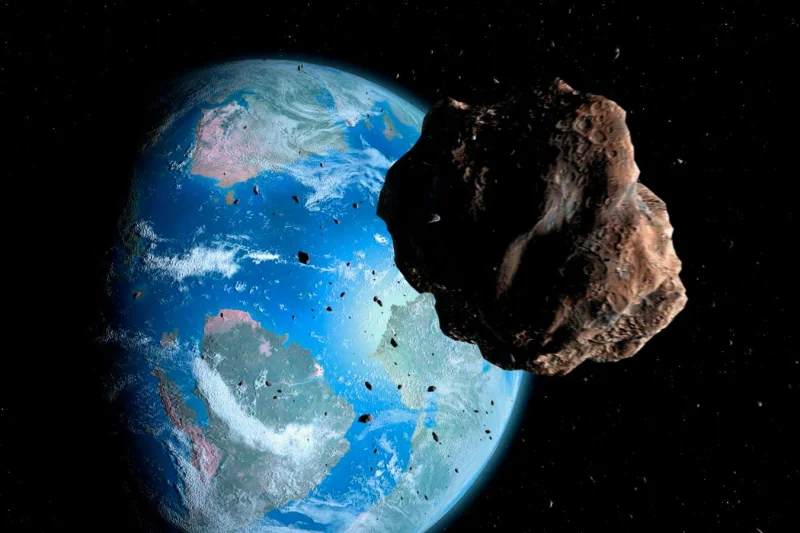
A near-Earth asteroid named 2026 JH2 will sweep past Earth on Monday, May 16, coming within 56,000 miles, or 90,000 km, of the planet. That is about a quarter of the average Earth-moon distance, and the object may pass closer to Earth than some satellites orbiting overhead.
The asteroid was added to the Minor Planet Center’s database after astronomers at the Mount Lemmon Survey in Tucson, Arizona, and Farpoint Observatory in Eskridge, Kansas, found it. Scientists have classified 2026 JH2 as an Apollo-class near-Earth object, a label for bodies whose orbit crosses Earth’s path around the sun. Its path appears to stretch from Earth’s neighborhood toward the outer solar system, though not quite as far as Jupiter’s orbit.
There is no chance of an impact from 2026 JH2. The asteroid’s absolute magnitude is 26.14, and estimates put its size at 50 to 115 feet, or 15 to 35 meters, across. Observations on 12 May suggested it was around magnitude 21.3, but it could brighten to approximately magnitude 12.8 by 19 May, making it easier to follow as it moves away after the flyby.
The close pass matters because astronomers keep watch on objects like 2026 JH2 precisely because their orbits bring them into Earth’s neighborhood again and again. The Virtual Telescope Project plans to broadcast the encounter live from Italy beginning at 3:45 p.m. EDT on Monday, May 18, giving viewers around the world a chance to see the asteroid only hours before its closest approach.
2026 JH2 is not the only object drawing attention this spring. Asteroid 99942 Apophis, first discovered in 2004, will pass just 20,000 miles, or 32,000 km, from Earth on Friday, April 13, 2029. At 1,230 feet, or 375 meters, across, it is far larger than 2026 JH2, and astronomers have already ruled out any collision risk for at least the next century.
Apophis will become visible from dark-sky locations such as Tenerife, Morocco and Mauritania, adding to the sense that a new generation of close asteroid passes is moving from theory into something people can actually watch. The comparison also recalls the Tunguska Event, when an asteroid about 330 feet, or 100 meters, wide entered Earth’s atmosphere and exploded above Siberia in Russia on Jun. 30, 1908, destroying 770 square miles, or 2,000 square kilometers, of forest. 2026 JH2 is nowhere near that scale, and that is the point: it is a close brush, not a threat.
