


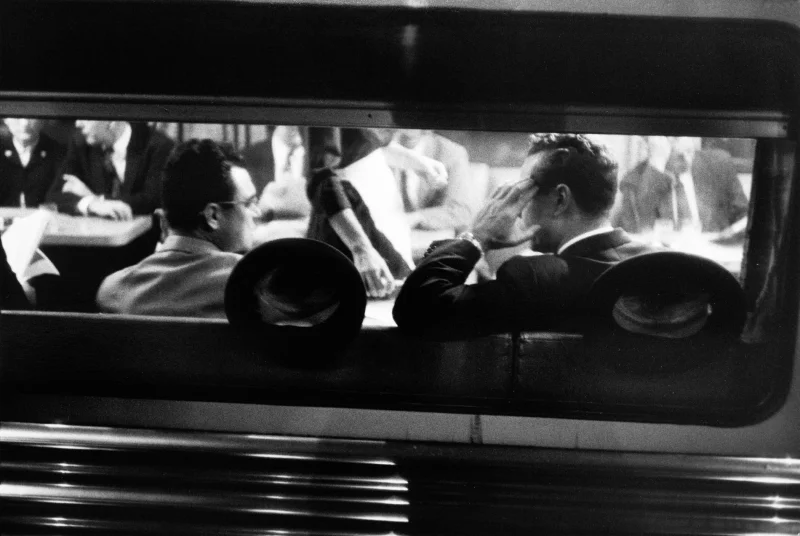
Louis Stettner saw a girl in a party dress skipping across balls of light on the stone floor at Pennsylvania Station in 1957, and the moment pulled him back a year later with his camera. He returned in 1958 to photograph the people moving through Penn Station NYC, turning the terminal into a record of a place he believed was already slipping away.
Stettner did not see the station as a backdrop. He said he liked scenes from “the smoke, fumes, the bustle” of the city, and he described those hurried spaces as places where there were “still moments or stray corners that have sometimes touched eternity”. His photographs from Pennsylvania Station now read less like transit scenes than like a time capsule from the last years of the original building, before the 1963 remodeling erased the world he had pictured.
The images mattered to Stettner because they came from a photographer who had spent World War 2 as a combat photographer and said that experience deepened his connection with “my fellow countrymen – fishermen, industrial workers, storekeepers – whom I had previously only brushed up against in Times Square”. After the war, he spent several years moving around Paris and made friends there with Brassai, Henri Cartier-Bresson, Robert Doisneau, Man Ray and Paul Strand. That European education, and his time among ordinary people, shaped how he looked at New York’s great terminal: not as architecture alone, but as a stage where public life revealed itself in passing.
Stettner said the original Penn Station was modeled on the Beaux-Arts Gare d’Orsay in Paris and was “like living in an art museum; it gave grace and charm to an ordinary function of going from A to B.” He contrasted that with the later station, which he called universally unloved and “continually anxiety-ridden.” In his telling, the new version compressed the very thing the old station had allowed to breathe. “People rush here and there,” he said. “They never post where the train is going to go, or which track it is.” “People bump into each other.” “There is no space.”
That friction is what gave his pictures their force. Stettner said, “People really got in touch with themselves whilst they were waiting,” and added, “It’s a complex thing, a very profound experience when people travel.” He worked, he said, on intuition: “If something strikes me as significant, I don’t censor what’s around me.” “I don’t come with any ideas to impose on reality; I let reality speak to me.” The result was a body of work that kept gaining meaning as the building it showed disappeared. “Time is the best proof of how valuable a photograph is, or how profound the content is,” he said. “The fact these photographs get more exciting with time is a good sign.”
That is the answer his Penn Station NYC photographs leave behind today. They are not just pictures of commuters under a famous roof. They are evidence of a station that once carried grace, crowding and uncertainty in the same frame, and of a city moment that ended with the 1963 remodelling. What survives now is Stettner’s record of that lost order, and the uneasy feeling that the old station, for all its noise, had given travelers something the replacement never did.
