


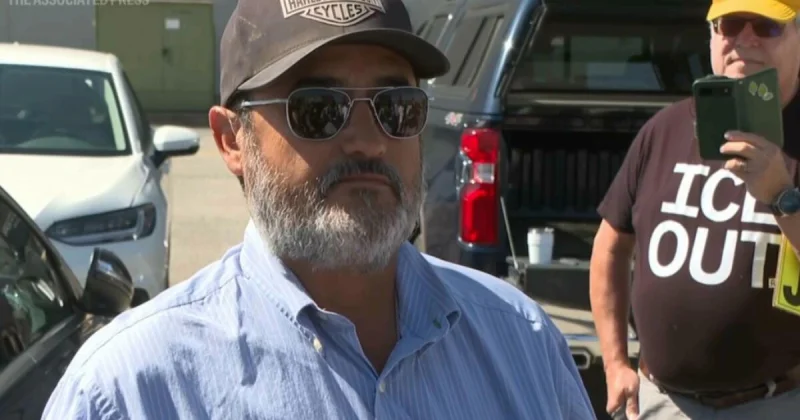
Federal immigration authorities detained Joe Ceballos on Wednesday during a meeting at an Immigration and Customs Enforcement office in Wichita, Kansas, turning a local voting case into a fight over deportation. Ceballos, 55, is a legal permanent resident who was brought to the United States from Mexico by his family when he was 4.
The arrest came after months of legal and political fallout from a 2025 citizenship interview in which Ceballos admitted he had voted. His lawyer, Jess Hoeme, said Ceballos apparently did not understand that his legal resident status did not allow him to cast ballots. Hoeme said the government had gone too far. “I’m extraordinarily disappointed in my government,” he said.
Ceballos’s path to Wednesday was shaped by a mistake he says began in childhood. At 18, he was encouraged to register to vote during a school trip to the Comanche County courthouse. He later served Coldwater, a town of about 700 people, as mayor twice and also sat on the city council, becoming a familiar figure in a community where local politics often happen in plain view.
The case sharpened after a citizenship interview in October last year, when he said he had voted. Kansas Attorney General Kris Kobach charged him with voting without authorization and electoral perjury. Ceballos won a new term as mayor in November and then resigned after the charges were filed. In April, Kobach’s office reached a deal with him, and he pleaded guilty to disorderly election conduct, a misdemeanor similar to disturbing the peace.
That agreement did not end the immigration case. Ceballos’s lawyers will ask a immigration judge to release him on bond, while his family and supporters gathered outside the Wichita ICE building Wednesday with signs and chants of support. Ceballos said he was shaken by what comes next. “Thinking about what could happen... is crazy,” he said. “Obviously I’m nervous. I don’t know what’s going to happen. I don’t know where they’re going to take me and what I can and can’t do in there.”
Hoeme said the government was treating a local politician like a criminal after a plea that did not involve fraud. “He has not been convicted of any kind of voter fraud. It should not have affected his immigration status,” he said. “The Trump administration and ICE have doubled down on the nonsense that he is a criminal.” The Department of Homeland Security recently referred to him as an “alien from Mexico,” a label that has only intensified the dispute over whether the punishment fits the offense. For Ceballos, the next decision rests with an immigration judge, but the broader question is already visible in Wichita: whether a decades-long resident who served his town can now be expelled over a vote he says he never understood he could not cast.
