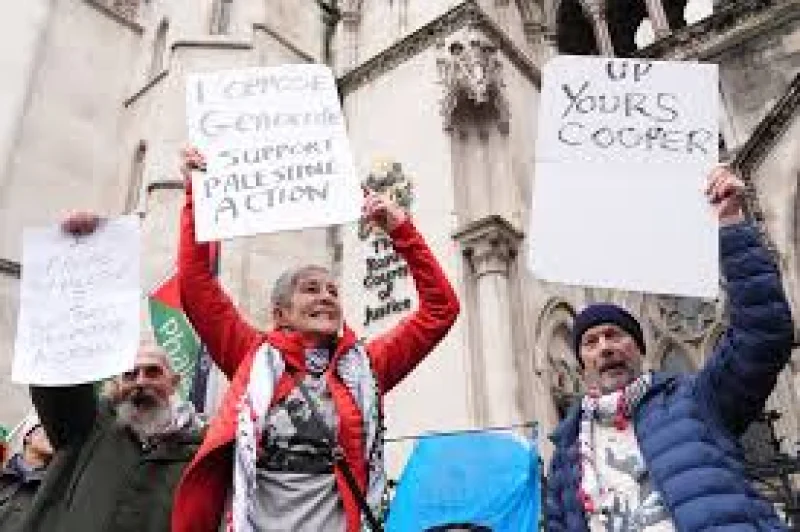
Rajiv Menon KC has won an unprecedented contempt of court challenge after the Court of Appeal stopped his forthcoming case on Tuesday, saying it was procedurally flawed. The senior judges did not shut the matter down for good, however, leaving open the possibility that the challenge could return under different rules.
The ruling lands after a bruising dispute tied to the February trial of six Palestine Action activists over a break-in at Elbit Systems, the British subsidiary of an Israeli defence firm. Last week, a retrial jury convicted four members of criminal damage, a result that sharpened the significance of the earlier fight over what the jury was told and when.
Menon’s challenge focused on the conduct of the first trial, where he clashed with the judge amid allegations that he had misled the jury. During the closing stages, Mr Justice Johnson issued detailed directions to barristers over their speeches, including an order that none of them could refer to “jury equity”. He also told jurors that if the defendants believed they had been morally justified in smashing up Elbit’s property, that would not amount to a “lawful excuse”.

That clash over language mattered because Menon’s own closing speech drew the jurors’ attention to a famous 17th Century Old Bailey case, a move that sat uneasily beside the judge’s attempt to keep the debate within strict legal bounds. The courtroom argument was not just over rhetoric. It went to the core of whether political motive could be presented as a defence, or whether it was simply a distraction from the criminal damage charge.
The Court of Appeal’s intervention now pauses what had been described as an unprecedented contempt case, but it does not resolve the wider dispute. The judges’ decision suggests the challenge was brought in the wrong form, not that the underlying complaint was without force. That leaves Menon with a narrow path back into court if the case is refiled under different rules.
For the defendants and for the wider Palestine Action case, the practical effect is immediate. One set of convictions has already been secured, another legal fight has been delayed, and the arguments over jury speeches, judicial control and the limits of “jury equity” remain very much alive.